
46+ Useful Indonesian Phrases for Travelers (A local’s pick)
This post may contain affiliate links. If you make a purchase using one of these links, I may receive a small reward at no extra cost to you. See my Disclosure Policy for more information.
As an English teacher, students frequently asked me what the easiest language in the world was. I would always say Indonesian (or Bahasa Indonesia).
Then I’d have to elaborate and go in a short history lesson.
Succinctly, Indonesian nationalists in the early 20th century needed a unifying language for all Indonesians from the over 17.000 islands spanning more than 5.000 km of longitude. They took the language that merchants used – Malay – standardized and simplified it. Ergo why it’s so simple.
Then in 1945, Independence was declared in Bahasa Indonesia. The language became a national symbol, a way to unite diverse cultures that spanned from Aceh in North Sumatra to the highlands of Papua (well, not until 1963, but you get the point).
All of these people spoke and continue to speak their own language. Over 750 languages. Most Indonesians don’t speak Indonesian with their parents – only 7% have it as a mother tongue. But for anything else – commerce, politics, travel, etc. it’s Bahasa Indonesia.
I have lived in Indonesia for a while now and I can confirm Indonesian seems quite easy. Studying through practice with locals and Duolingo, I can now say Indonesian phrases like “If you speak slowly, I will understand you” and “There is no rich bear in this century” (this one is a real exercise from Duolingo).
Although I have a long way to go to become fluent, at least allow me to show you my list of the most useful Indonesian phrases to have under your belt. And with an actual Indonesian (okay, her mother tongue is Javanese, but as noted, that’s the case for 93% of Indonesians) proofreading and checking this article, you can be sure this is top-notch.
Why learn some Indonesian phrases at all?
- Locals don’t speak English. You may get away with it in Bali due to the tourism boom but anywhere else you’ll be left with just hand gestures and body language;
- Better prices. Speak a little Indonesian and you automatically gain +10 skill in bargaining;
- Stand out from the crowd. Most foreigners (bules) don’t speak Indonesian. If you do, even just a few phrases, locals will notice immediately;
- Get called smart. I always get called smart when I speak basic Indonesian. “Kamu pintar!” and it feels nice! You surely will too!;
- Cultural Immersion. Learn a bit more and you can have some longer conversations that are a lot more meaningful and insightful.
The Magic Words
Here are the most important words in Indonesian.
- ‘Thank you’ in Indonesian is “Terima Kasih”
It translates to ‘Receive Love’ and I think it’s beautiful. For a more casual ‘thanks’, shorten it to “Makasih“. The ‘h’ is silent.
Add “banyak” to make it thank you very much; i.e. Terima kasih banyak!
- The answer is “Sama-sama”, meaning ‘you’re welcome’.
- ‘Please’ in Indonesian is “Tolong”
That’s what you’d be saying when you want something. Restauranteurs on the other hand will greet you with “Silakan“, meaning “please come in”.
- ‘Sorry’ in Indonesian is “Maaf”
That’s for when you bump into someone on the street. Or if you screw up.
- ‘Excuse me’ in Indonesian is “Permisi”
That’s for when you want to pass by someone and don’t want to hit them. Or when you want to call the waiter. Or when there’s nobody in front of the warung and you want to call the vendor.
Indonesian Greetings
These are for when you meet people. Be mindful of the time of day but don’t worry too much – locals will happily correct you to the proper one.
- Hello = Halo;
- Good morning = Selamat pagi (use before 11 AM);
- Good afternoon = Selamat siang (use from 11 AM to 3 PM);
- Good afternoon = Selamat sore (use from 3 PM to sunset);
- Good evening/night = Selamat malam (use after sunset).
“Selamat” literally means ‘congratulations’ but is used in the sense of ‘good’ for greetings. For more informal greetings, drop the “selamat”: Say just “pagi”/”malam” to people you’ve met a few times already.
The following phrases are for when you part ways with someone:
- Goodbye = Selamat jalan (if they leave and you stay);
- Goodbye = Selamat tinggal (if you leave and they stay).
Personal Introduction
We can go down a rabbit hole about all the ways to introduce yourself and all the things you could say. But these two are the most basic Indonesian phrases:
- My name is Simon = Nama saya Simon;
- I am from Bulgaria = Saya dari Bulgaria.
If you’re to then ask for your conversation partner’s name, it would be “Siapa nama kamu?“
Other Essential Phrases
These phrases are also quite important and round up your “I’m staying in Indonesia for just a week” course.
- How are you? / What’s up? = Apa kabar?
How are you in Indonesian is “Apa kabar”.
The usual answer is “baik” which is the equivalent of ‘fine’. I’ve never heard anything different than baik as an answer.
The saying has an Arabic root as kabar means “news” in Arabic. Thus, what you’re really asking is “What’s the news?”
- Yes & No = Ya & Tidak;
You may also hear “nggak” used as ‘no’. That’s for informal situations and with people you know.
Keep in mind that if you ask whether a shopkeeper has a particular item and they don’t, they will usually say “Kosong” (literally meaning empty/blank/0) instead.
- Take care (be careful) = hati-hati;
That’s often used in combination with goodbye to wish someone well.
- See you later = sampai jumpa (lagi);
It’s also often used when saying goodbye to someone.
Numbers in Indonesian
To count, say how many or for money, knowledge of basic numbers is very important in any country. Here’s how they are in Indonesian:
- 1: Satu;
- 2: Dua;
- 3: Tiga;
- 4: Empat;
- 5: Lima;
- 6: Enam;
- 7: Tujuh;
- 8: Delapan;
- 9: Sembilan;
- 10: Sepuluh (20 = dua puluh, 30 = tiga puluh…);
- 11-19: add “belas” (sebelas, dua belas, tiga belas…);
- 21+: add “puluh” (28 = dua puluh delapan, 73 = tujuh puluh tiga);
- 100: Seratus (200 = dua ratus, 300 = tiga ratus…);
- 1.000: Seribu (2000 = dua ribu, 3000 = tiga ribu…);
- 100.000: Seratus Ribu (200.000 = dua ratus ribu, etc);
- 1.000.000: Juta.
With money in Indonesia having a lot of zeroes, it pays to learn even the big numbers.
Keep in mind that locals often ignore the last 3 zeroes. If something costs 25.000 IDR, they may just say “dua puluh lima” or even just “dua lima”.
Questions
The cool thing about conversational Indonesian is that any statement can be a question with the proper intonation without any change in grammar or word order.
For example ‘You are hungry‘ and ‘Are you hungry?‘ can both be “Kamu lapar” in Indonesian with the right intonation.
In short: you can just omit “apakah” and “adalah” (the proper Indonesian question words) from your everyday conversations.
- How much does … cost? = Berapa harga…?
You would usually point at something when you say this. If it’s close, you’d say “berapa harga ini?“, if it’s far you’d say “berapa harga itu?” and if you know the name, you’d say something like “berapa harga nasi goreng?“
- Where is…? = Di mana…?
For example, ‘Where is the toilet?’ becomes “Di mana toilet” in Indonesian. Some other words you would commonly use that question with are:
- Wash basin = wastafel;
- Museum = museum;
- Restaurant = Rumah makan / warung;
- Market = pasar;
- Bus stop = halte;
- Train station = stasiun kereta api;
- Airport = bandara;
- Beach = pantai;
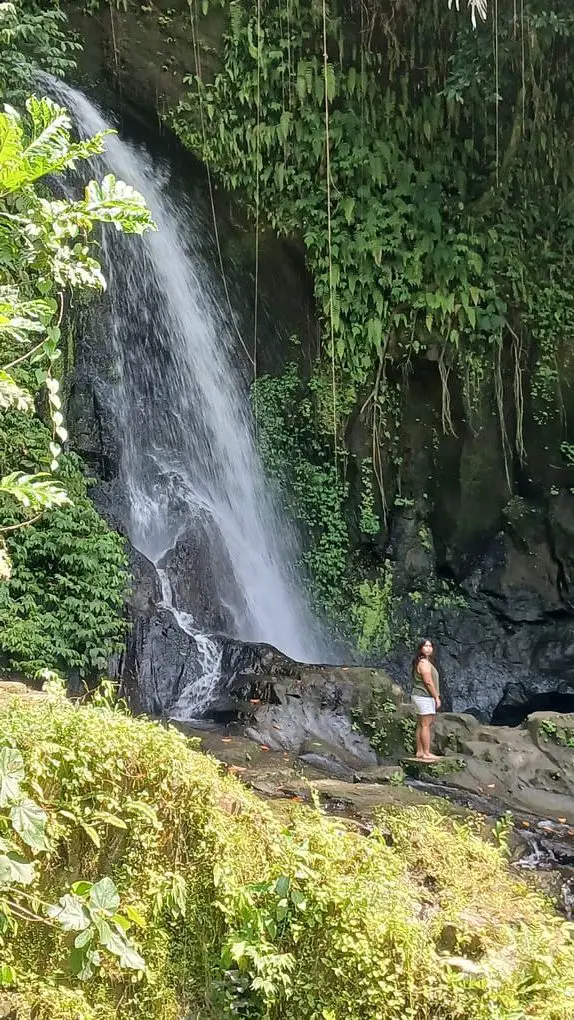
- Waterfall = air terjun.
- Is there…? = Ada…?
The simplest way to ask if a restaurant or a supermarket has something is with “ada“. For example ‘Do you have ice tea?” becomes “Ada es teh?” and “Is there toothpaste?” becomes “Ada pasta gigi?“
- May I…? = Boleh…? (asking for permission)
For example, ‘May I sit here?’ becomes “Boleh saya duduk di sini?” but if you can’t remember this, just say “Boleh?” pointing at whatever you want permission for.
- Can I pay with card? = Bisa saya bayar dengan kartu?
Just keep in mind that payment by card in Indonesia is rare – only in bigger supermarkets, hotels, and cafes. Read more about cash, cards, and ATMs in Indonesia.
Indonesian Phrases about Food
You can’t go to Indonesia and not have some delicious food. Just please don’t stick to pizzas and burgers in the main tourist areas of Bali.
Instead have some nasi goreng, ayam bakar, mie ayam, sate, gado-gado, ikan bakar, etc. Don’t forget to indulge in some Indonesian snacks and desserts too.
Food Vocabulary
- Chicken = ayam;
- Lamb/goat = kambing;
- Beef = daging sapi;
- Pork = babi;
- Fish = ikan (check my article about the Jimbaran Fish Market for more seafood vocab);
- Rice = nasi;
- Mie = noodles;
- Egg = telur;
- Vegetables = sayur;
- Fruit = buah;
- Grilled/roasted = bakar;
- Fried = goreng;
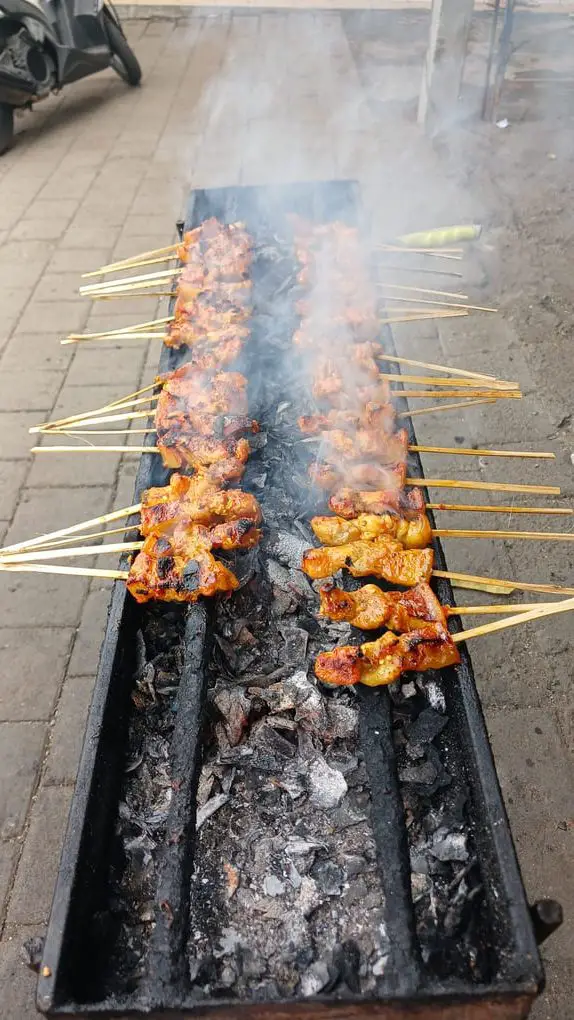
- I want to order = Saya mau pesan
That’s for when you’re done looking at the menu and are ready to also say “Saya mau …”, i.e. what it is that you want to eat.
- Less spicy = kurang pedas
Indonesian cuisine is notoriously hot. While locals rarely need to say that phrase when they order, if your tongue doesn’t do well with heat and pain, you may want to say “Tolong, kurang pedas” or “Jangan terlalu pedas” (don’t make it too spicy).
- More spicy = lebih pedas
Warning! Proceed with extreme caution when requesting higher degrees of spiciness! You don’t know what you’re getting yourself into and may regret it!
Now that I’ve warned you, go ahead and say “Boleh tambah pedas?” for a more complete request (literally ‘Could you put more spice?’).

- Delicious! = Enak!
If your food tastes good, congratulate your cook! And if the food is exceptional you may also go for “Lezat!“, meaning ‘delectable’.
- Do you have vegetarian/vegan food? = Ada makanan sayur sayuran?
Alternatively, if you have dietary restrictions and allergies, ask if the food contains these ingredients by asking “Makanan itu ada [ingredient]?” and then add “Saya alergi“.
You can also clearly state what it is that you don’t eat by saying “Saya tidak makan [type of food]“
Phrases for Bargaining
Shall you ever go to a market in Indonesia, be prepared to either pay triple (at best) or bargain your way down to a more reasonable price.
The most successful way to bargain is to be Indonesian. As racist as this may sound, no matter how good your bargaining or language skills are, you will be paying more than a local.
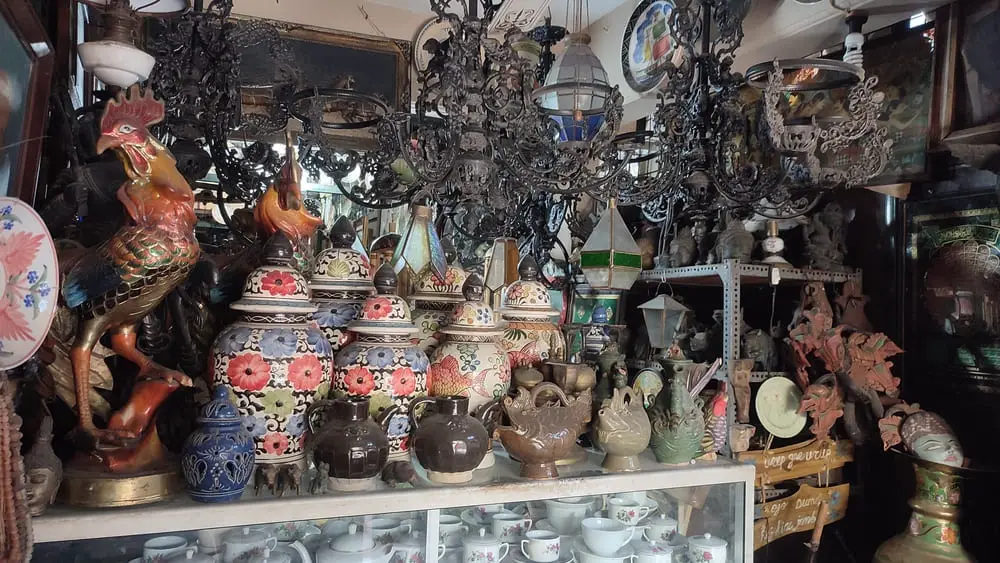
These phrases will help you reduce that gap if even by just a little.
- (Too) expensive = (Terlalu) mahal!
The key here is to not say it in a rude way. I’ve made that mistake many times without realizing only to have my Indonesian partner tell me that the locals found my tone of voice too aggressive. I didn’t mean it, I swear, I guess it has to do with my Balkan character. Those from the Balkans will understand.
So if you don’t want to burn any bridges, say this softly without too much expression and counter with an offer politely.
- Can you give me a discount? = Bisa kamu beri diskon?
That’s another way to start the haggling process. However, this way you don’t control the second price = the merchant will reduce by, say, 10% making the anchoring effect of the first offer even stronger.
Remember that the first price you hear in very touristic areas is usually more than double the real price. Thus, you’d ideally be aiming for a 50% discount.
- Can you go lower? = Boleh kurang?
- More discount? = Diskon lagi?
- Still too expensive = Masih terlalu mahal
If after a bit of back and forth, the vendor price still seems too much, say this…:
- Sorry, I can’t = Maaf, tidak bisa
…and start walking away. 9 times out of 10, the vendor will call you back with a final discounted offer.
And here are some more bargaining phrases, also a little humorous given that you’re a foreigner:
- But I’m so poor = Tapi, saya miskin sekali
- I don’t have (enough) money = Saya tidak punya (cukup) uang
- Can we split the difference? = Bisa separuhnya?
- My husband/wife will kill me = Suami/istri saya akan membunuh saya
Some more random phrases
These didn’t make it into any of the categories above but I felt like including them because they have their important uses.
- Foreigner = bule
Indonesians don’t mean this in a derogatory way although it’s almost exclusively used for white Westerners.
- I don’t understand = Saya tidak mengerti
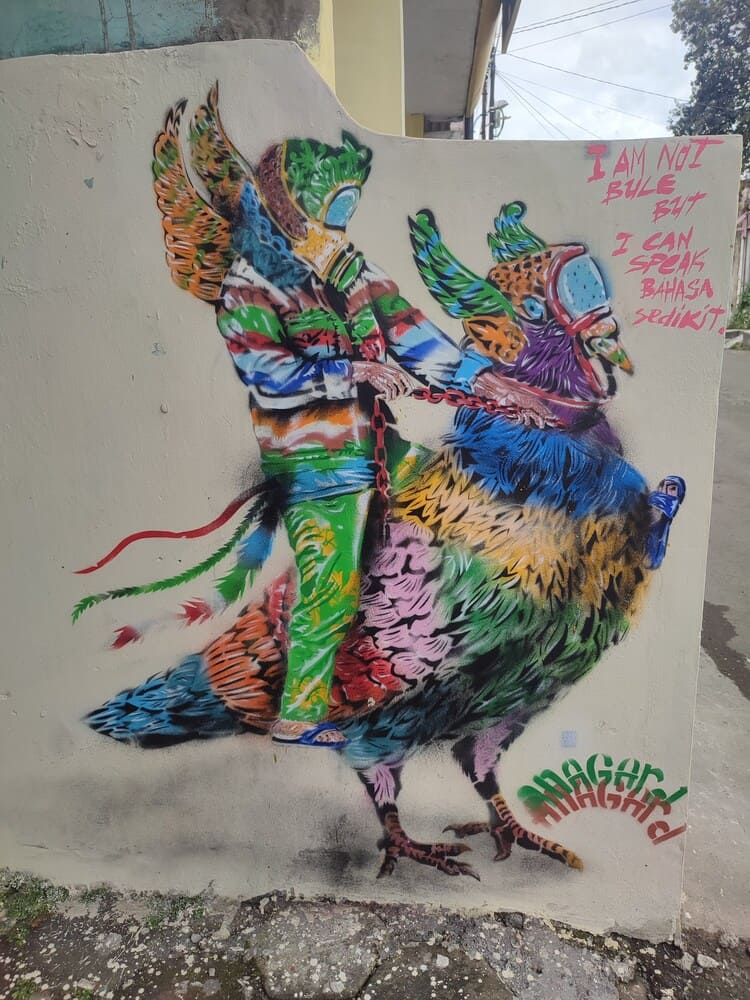
- I know (only) a little Indonesian = Saya bisa Bahasa sedikit
- Do you speak English? = Kamu bisa Bahasa Inggris?
- Good luck = Semoga beruntung
- Cheers! = Bersulang!
- What time does it open/close? = Jam berapa buka/tutup?
- I like you = Saya suka kamu
A few notes about Indonesian pronunciation
The Latin alphabet was chosen for the Indonesian language due to Dutch cultural/linguistic imports and practical considerations.
Initially, it used Dutch spellings for certain words. Some of them stick to this day, for example, Yogyakarta‘s nickname is still Jogja, from the Dutch spelling Djokdjakarta.
This also means that most words in Indonesian today are pronounced like you’d read them in English (but without the weird rules like the pronunciation of ‘colonel’).
Here’s the jist about pronunciation:
- ‘C’ always makes the sound ch. For example “membaca” is pronounced “membacha”;
- ‘Ng‘ – to pronounce this, open your mouth, move your tongue back, and close your throat with your tongue as you’re saying the ‘g’. It’s similar to the way you pronounce ‘sing’ but throatier;
- Words that end in ‘k’ use what’s called a “glottal stop”, i.e. the ‘k’ is almost not pronounced at all.
- ‘E’ is pronounced like in ‘berry’ if it’s stressed (“es”, “terima kasih”, and “restoran”). If it’s unstressed, it’s pronounced like in ‘taken’ (“kerja”, “sepuluh”, and “berapa”).

