
Money in Vietnam: A Tourist Guide to ATMs, Cards and Exchange
This post may contain affiliate links. If you make a purchase using one of these links, I may receive a small reward at no extra cost to you. See my Disclosure Policy for more information.
This is for all travelers to Vietnam who want to know how to handle money and payments in the country of the Dong.
Everything you need to know about using your card, exchanging money, and which ATMs don’t charge access fees!
| Best foreign currency to bring | USD, Euro, AUD, GBP, etc |
| Where to exchange? | Gold shops, banks |
| ATMs without a fee | |
| Can you withdraw USD directly? | No |
| Can you use Revolut and Wise? | Yes! |
| Cash or card? | Cash |
This is the full guide to money in Vietnam for tourists!
Currency in Vietnam
The currency in Vietnam is the Vietnamese đồng with code VND.
First things first – don’t laugh at the name! It’s the name for the copper material of the coins in Vietnam’s ancient past. In modern times, it just means money, plain and simple, really nothing phallic about it.
It’s one of those currencies with a lot of zeroes. Rampant inflation after 1985 resulted in one of the weakest currencies (unit for unit) in the world. This is the case to this day.
Also, the proliferation of the joke that everybody is a millionaire in Vietnam: 1 million VND is only about 40 USD.
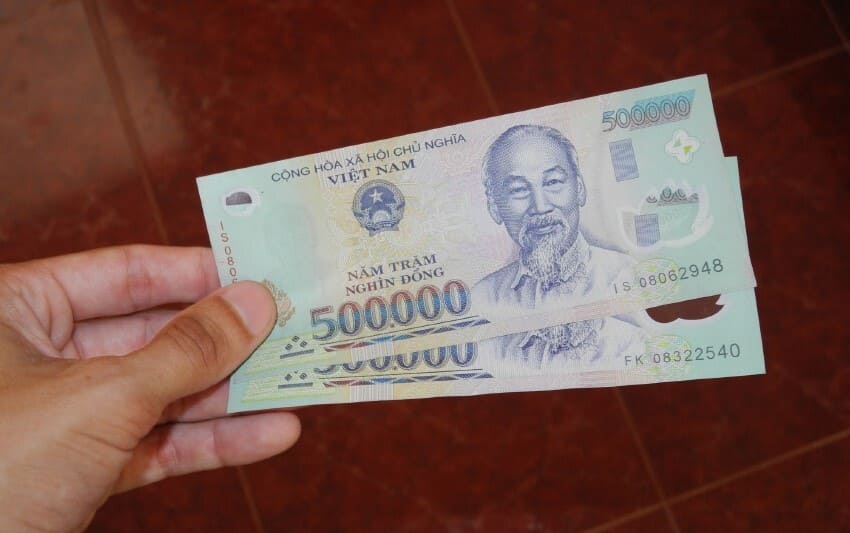
There are no coins in Vietnam anymore.
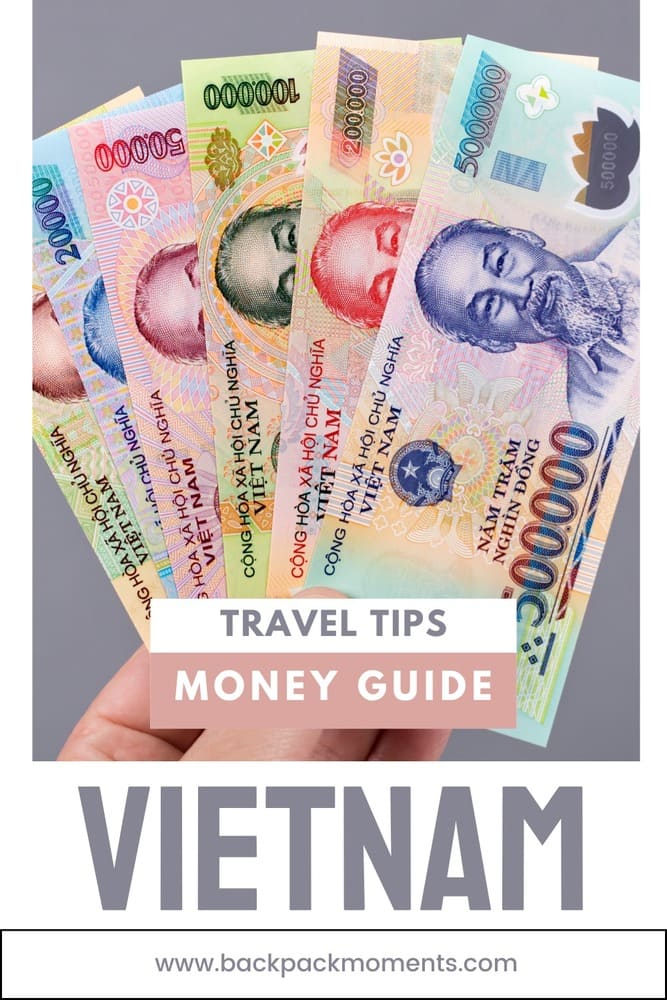
The banknote denominations are 500, 1000, 2000, 5000, 10.000, 20.000, 50.000, 100.000, 200.000, and 500.000.
All banknotes 10.000 and over are now made of polymer, making them very durable (unlike money in Laos, where you also have to carry lots around and they get ruined pretty quickly, being of cotton).
The biggest banknote of 500.000 VND (~20$) means you don’t have to carry a thick lump of money like with the Indonesian Rupiah. Twenty dollars may not seem much, but in Vietnam, that’s a lot of money.
Can you use your card in Vietnam?
Yes, you can use your foreign card to pay for some things in Vietnam.
Foreign card payments are not that common, though. You can pay by card in cities and popular tourist hotspots. Bigger hotels, bigger supermarkets, and most tour operators will also accept payment by card.
Some places may charge a 2% to 4% commission. In such cases, it’s better to pay in cash – it’s cheaper even factoring in the exchange rate margins.
Smaller supermarkets, traditional open-air markets, family-run guesthouses, etc., of course, only accept cash. Imagine going to a floating market on the Mekong Delta and trying to pay by card, ain’t happening mate!
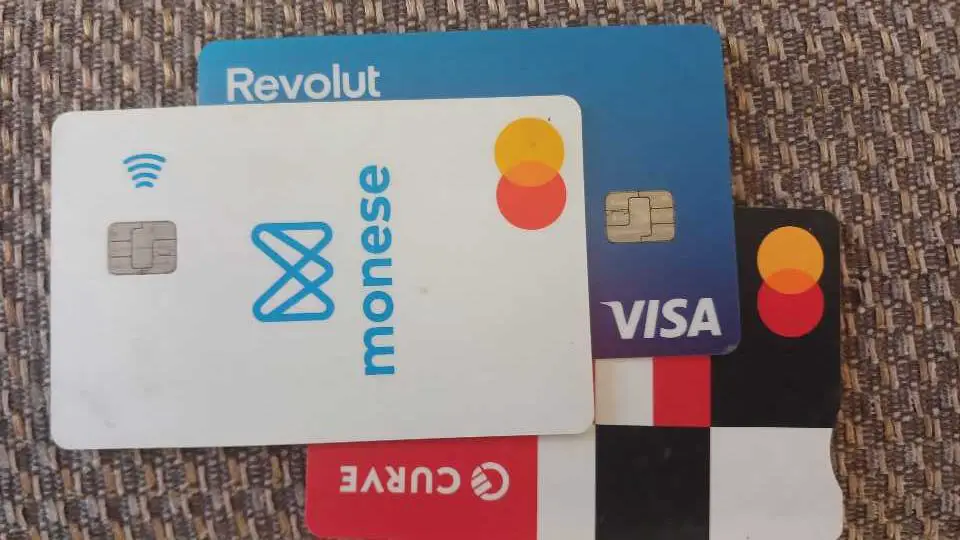
All kinds of cards are accepted: Visa, Mastercard, Maestro, and American Express. Look for the signs at the entrance.
ATMs in Vietnam
ATMs are everywhere in the cities of Vietnam. You won’t have to walk more than a few meters to find an ATM.
However, in more remote locations like Ha Giang region in the far north, rural villages around Sapa, or off-the-beaten-track destinations in the Vietnamese Highlands, finding an ATM may prove much harder.
ATMs almost universally accept Visa and Mastercard. For Maestro and AMEX, you may have to try a few ATMs before you find one that accepts your card.
Most ATMs in Vietnam let you withdraw between 2 and 10 million VND per transaction. The maximum single withdrawal is 10 million VND at VPBank.
Withdrawal Fees
Here comes the tricky part – avoiding those pesky ATM withdrawal fees. I’m not talking about the fees you get charged by your bank – those you can avoid by using a FinTech solution like Revolut or Wise.
Most ATMs in Vietnam charge a withdrawal fee between 20.000 and 55.000 VND (0.8-2$) per transaction. Since the maximum on most (e.g., Agribank, Vietinbank, and Vietcombank) is only 3 million VND per transaction, these fees stack up quickly.
Thankfully, 2 banks don’t charge a fee for withdrawing with a foreign card.
ATMs without withdrawal fees
VPBank and ACB are the only ones in Vietnam to offer free withdrawals.
The maximum withdrawal per transaction from a VPBank ATM is 10 million VND, making it the better of the two (ACB allows only 3 million VND per transaction).
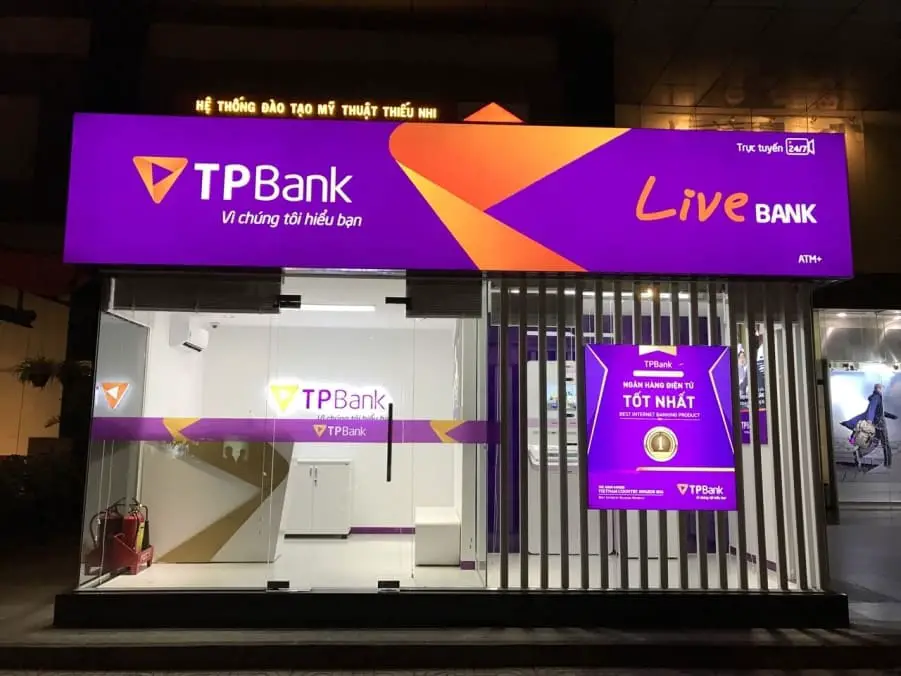
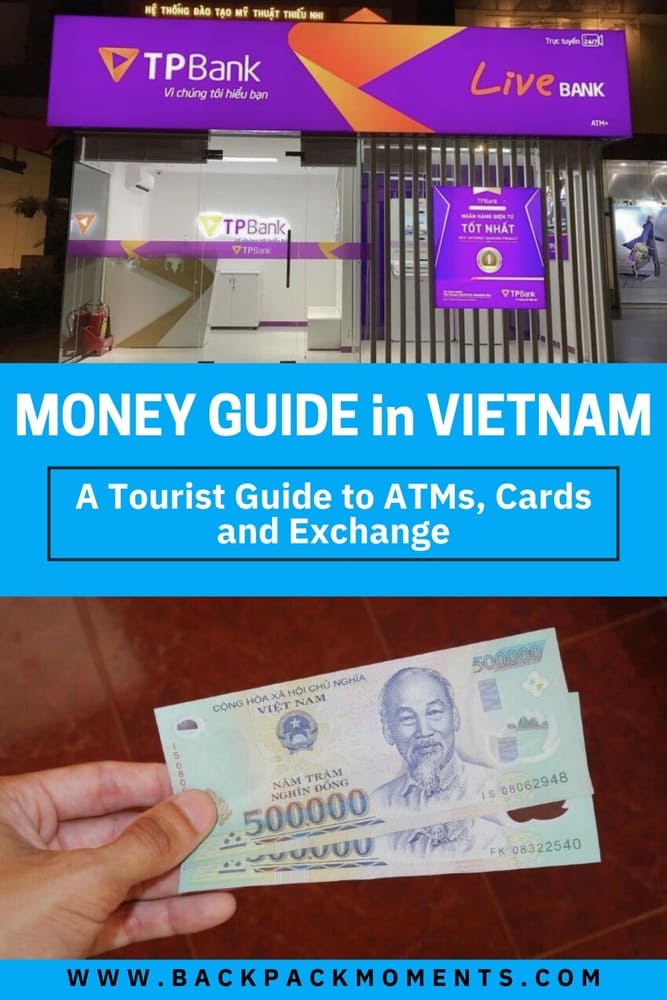
TPBank used to be free for foreign cards too, but since June 2025, it has also introduced a fee for withdrawals. As of October 2025, this fee is now around 3.3% of the withdrawn amount, which makes it the most expensive ATM to use now.
Although most ATMs will tell you if there’s an access fee, some in Vietnam don’t. You will only realize you paid a 50.000 VND fee when you check your bank statement. Urghh!
The best ATMs in Vietnam are those of VPBank and ACB because they don’t charge a fee for withdrawals. Guaranteed, tried and tested! Feel free to send me an angry message if they charge you a withdrawal fee!

And yes, I did try most of the other banks, including Agribank, Vietinbank, Vietcombank, BIDV, Shinhan Bank, HSBC, and more that I don’t remember the names of. They all charge an access fee.
The fee is usually 55.000 VND per withdrawal, with a maximum amount of 3 million VND.
You can find VPBank ATMs on Google Maps. They’re not the most common, but there are at least 1-2 in every city (and more in Hanoi and Ho Chi Minh City).
VPBank is easily recognizable by its bright green and red colors.
Exchanging Money in Vietnam
You don’t have to exchange money in Vietnam if you have a card with low fees like Revolut or Wise. It may turn out to be more expensive to exchange cash than to withdraw from an ATM, depending on the exchange rate margins you get.
Don’t forget the hassle of searching for a fair exchange bureau and the mental strain of avoiding scams (plentiful in Vietnam).
But I understand if you carry cash when traveling and want to exchange it for the local currency. So here’s how to be prepared for exchanging money in Vietnam.
What currency to bring
As with almost anywhere in the world, the US dollar is the best foreign currency to carry to Vietnam.
You will have no issues exchanging these currencies, too:
- Euro;
- British Pound;
- Japanese Yen;
- Chinese Yuan;
- Swiss Franc;
- Australian Dollar;
- New Zealand Dollar;
- Canadian Dollar;
- Singaporean Dollar;
- Malaysian Ringgit;
If your currency is not on the list, it’s better to change your money to something more widely accepted before you come to Vietnam.
I once tried to exchange 20 euros in Vietinbank, where they told me they only change US dollars. I was quite surprised – the Euro is one of the world’s most accepted currencies.
But the bank next door, Agribank, gladly accepted the euros and exchanged them in a few minutes. At the end of the day, it was pretty easy and quick.
Where to Exchange Money
Vietnam is a popular travel destination, and exchanging money is widespread.
You can exchange at:
- Banks: Takes a few minutes. Bring your passport!
- Exchange bureaus in a city: Good rates
- Gold and Jewelry stores: Most double down as exchange bureaus, and their rates are usually the best. Note that the authorities have started cracking down on illegal gold shop exchanges – only use licensed operators!
- Airports: worst rates. If you must, exchange a small bill to get you to the city, then exchange more there.
- Hotels: better than at the airport, but still bad.
- Tour Agencies: bad rates considering there’s usually a bureau or a gold shop nearby.
- Dodgy guy at the market: You’re setting yourself up to be scammed.
After the many times I’ve been in Vietnam and the many travelers I’ve spoken to, I believe Gold Shops are the best places to exchange money in Vietnam. They have very competitive rates and are unlikely to scam you. You will normally find them near markets in cities.
In touristy areas, you will likely find small exchange kiosks on the street, usually near the night market. These offer surprisingly good rates, often within 0.4% of the mid-market rate, but do be careful about hidden commissions and the cheeky sleight of hand. Just don’t exchange too much at once, and you will be okay.
Tips for Changing Money in Vietnam
Most of these are common sense and not any different from other countries.
Here are my top tips:
- Higher denominations = higher rates. For USD, 50 and 100 yield a slightly better rate.
- Damaged banknotes = lower rates + fee (if accepted at all);
- Don’t accept foreign banknotes with ANY damage (if changing Dong back to USD, for example);
Pro Tips and Common Scams
Scams are one of the reasons I don’t like Vietnam. I don’t get scammed easily, but even so, it takes energy and mental fortitude to avoid all the ways in which you can overpay unfairly.
I’ve compiled some smart tips from my travels to Vietnam and fellow travelers’ confessions to give you a heads-up.
- Polymer STICKS when even a little wet. Count your banknotes slowly and twice!
- Never take any banknotes with tears or holes.
- Check banknotes against light (use your smartphone flashlight in the dark) to confirm they are not forgeries. Fake banknotes are rare in Vietnam, but they do exist.
- Be careful with the so-called “Spirit Money”. These are fake banknotes made of poor-quality paper, for burning and Buddhist ceremonies. They vaguely resemble real USD or VND banknotes but fail to withstand scrutiny easily. Nonetheless, in the dark, some not-so-kind individuals may try their luck with you.
- Mentally ignore the last 3 zeroes to make calculations easier. 50.000 is just 50k, 20.000 is 20k.
- Know the multiple of your currency. Say you use US dollars, and 10.000 VND is about 0.4$. Your multiple is 4. If something costs 40.000 VND, ignore the zeroes, multiply by 4, and you have 16, i.e., 1.6$; Quick maths: 230k VND? -> 2.3*4 =~9.2 USD.
- 10k, 50k, and 200k are in a similar shade. Be careful!
- 20k and 500k are also in a similar shade. Be very careful with these two!
- The most common scam is when you pay with 500k, the receiver then secretly switches it to 20k, and pretends he only received 20k. Taxi drivers are known to do this. They start being aggressive, and it can get ugly quickly. Change 500k notes to smaller ones at reputable establishments!
How much cash to bring to Vietnam?
This depends on your way of traveling and your budget. Withdrawing cash with your card in Vietnam is pretty easy, so there’s no need to go overboard with physical cash.
My advice is to have at least 200$ just in case something goes wrong with your bank cards, and you need emergency cash until you sort it out.
The first time I went to Vietnam, I had exactly that much stashed away, but since I exclusively used my Revolut and Curve cards, I didn’t need to exchange any.
On the other hand, if you’re wondering how much money you need to travel to Vietnam, you can check out my backpacker’s budget report for Vietnam.
Example prices
Here are some example prices to get an idea. All prices are in Vietnamese Dong (VND).
Note: 10.000 = 10k = ~0.4$
- Coffee with milk: 15k – 30k
- Pho soup: 35k – 50k
- Banh Mi sandwich: 6k – 30k
- Passionfruit cooler: 15k – 25k
- Can of beer (supermarket): 8k – 20k
- Can of beer (street bar): 15k – 40k
- Museums: 20k – 50k
- Public bus ticket in HCMC or Hanoi: 6k – 10k
- 1-hour full-body massage: 200k – 400k
- Budget hostel: 30k – 220k (usually breakfast included)
- Mid-range hotels: 300k – 800k
- Half-day group tour: 500k – 1 million
- Overland bus travel: ~50k per hour of travel
- Travel Insurance from SafetyWing (covers you in Vietnam): ~56 USD for a 1-month trip.
See my budget report for Vietnam for a look into my expenses over a month in the country.
Bargaining
Bargaining is an inseparable part of buying anything in Vietnam.
In the eyes of locals, any foreigner is rich. Thus, the first price you hear is often more than 3 times what the locals pay.
It’s not uncommon to get a price 10 times higher than the actual!
As a foreigner, you will never get the locals’ price. But if you bargain playfully and politely, you can easily get at least a 50% discount most of the time.
Always assume you are getting the “tourist price” and ask for discounts. Because usually you are!
When I say always, I mean it – you can bargain for bus tickets, food, clothes, coconut on the street, walk-in accommodation, coffee, etc.
I have been overcharged for meals, drinks, transportation, fruits, lattes, etc. After getting bolder and smarter, I no longer assume the price in Vietnam is fair – on the contrary, I assume the real price is lower. And it usually is.
You will be overcharged if you don’t bargain. You will be overcharged even if you do, but at least not as much.
Tipping
Tipping is not mandatory in Vietnam.
It’s not expected, and it’s not common. Vietnamese people rarely tip.
And considering that you’re paying the tourist price already, one could assume that the tip is automatically included.
If you encounter genuinely friendly staff, exceptional service, and are overall happy with the way you were treated/pampered, do tip. It will bring smiles and good fortune your way!
Frequently Asked Questions
Let’s answer some of your most burning questions about money in Vietnam.
What is the ATM withdrawal limit in Vietnam?
The maximum withdrawal limit is 10 million VND (~380$) at VPBank ATMs.
VPBank doesn’t charge a withdrawal fee, so you can withdraw twice, thrice, or more in a row. There is no daily limit, but you may have one set by your bank.
Your bank may charge a fee, though! Wise and Revolut have fee-free limits up to around 7-8 million VND only!
Can you use US dollars in Vietnam?
You can use US dollars to pay for SOME things in Vietnam.
For example, tours are usually advertised in dollars and are payable in dollars too.
For most daily transactions, though, only Vietnamese Dong is accepted.
Can you use Revolut in Vietnam?
Yes, Revolut cards work in Vietnam. Both VISA and Mastercard work. You can withdraw from ATMs and pay at POS terminals with your Revolut card.
Similar fintech apps like Wise, Monese, Curve, N26, and Starling also work there.
If you are going to other Southeast Asian countries, you may want to read my money guides for them too:
- Tourist Guide to Money in Laos
- Tourist Guide to Money in Cambodia
- Tourist Guide to Money in Thailand
- Tourist Guide to Money in Myanmar
- Tourist Guide to Money in Malaysia
- Tourist Guide to Money in Timor Leste
- Tourist Guide to Money in Indonesia
- Tourist Guide to Money in the Philippines
Hi Simon
Just returned from Vietnam (Nov 2025). I was not charged a fee withdrawing cash from a Keinlong Bank ATM in Hanoi using a Revolut UK card.
Regards, Steve
Hi Steve,
That’s the first time I hear about Keinlong Bank but it’s awesome that more banks offer free withdrawals!
-S.
Just to let you know that tp bank charge 3.3% on transactions since October, so it’s best to let people know not to use their atms now as they are the most expensive. Please update your blog as I went on what you wrote
In veitnam now Simon…thanks for all the information and trips…very interesting…well done.
.
Just to let you know that tp bank charge 3.3% on transactions since October, so it’s best to let people know not to use their atms now as they are the most expensive. Please update your blog as I went on what you wrote
Hi Simon, sorry my mistake it is VP Bank. The video details are below.
Tp bank charged 165,000 dong for taking out 5,000,000. Hopefully vp bank still charge 55,000 for 10,000,000 withdrawal. I will let you know
TPbank has indeed introduced fees for withdrawals which was reflected in the guide since August 2025. I learn from you that they have increased it again, from a reasonable 55k to a whopping 3.3%. I have updated the article accordingly.
VPbank on the other hand shouldn’t charge any fees for withdrawals. Last I checked was in August 2025.
Thank you. I will let you know about tp bank later. Also vp bank didn’t show that there was an atm charge on the screen. You won’t find out until you look at your transaction online
Sorry, Yes, you’re right you did put it up that on your page. I got confused with tp bank and vp bank. Thank you
Hi, have seen on a recent YouTube video that APBank are now charging a withdrawal fee at ATM. Have you experienced this or heard of it?
Not sure which one APbank is, but last time I checked, VPbank and TPbank were still without a withdrawal fee.
-S.
TPBank withdraw fee: I have made 3 times withdraw from this bank during January 2025. First time TPB charged me fee: 7936 VND, Second time : 87500 VND, Third Time : 98933. I did withdraws with Wise Visa debit Card. Has anyone know why TPB fee changes time to time?
Thank you for any response
These fees seem very random, so to speak. Are you absolutely sure they came from the ATM and not from Wise if you have gone above your limit?
I’ve used TPBank many times and never been charged a fee. Unless they’ve added fees in January, who knows…
Hi,
I will send copy of transactions by email to you later. It looks all mentioned deductions as stated in my massage, are TPB ATM’s fee!!!
Hi Henrik,
I saw your email and the transactions you have made. I am afraid you were charged by Wise. You were above your free limit so you were charged 1.75% of the amount + a flat fee if over 2 withdrawals monthly. These fees and the monthly limits are listed in the app.
I know this for sure because if the charge comes from the ATM it shows as “3rd Party fee” on Wise whereas yours says “Our ATM fee”.
TPBank didn’t charge you anything for the withdrawal.
Best,
Simon
Hi , I have got very good explanation from Simon. TP Bank fees were actually Wise ATM fees.
Thank you Simon for your research and useful information about the way Wise calculate ATM fee.
Hello, I am from the US and will be traveling to Vietnam in December.
It will be my first time; I normally carry Cash with me and credit card is my last resort.
Is there banks inside the Noi Bai Airport that I can exchange my $$ to VND?
You mention airport had the worst exchange rate.
Any suggesstion
Hello Vangeline,
Seems common with Americans to rely on cash and see a card as back up. I am the opposite – I carry little cash and rely on a couple of cards to take cash out from ATMs. For long term travel, it works out more convenient and cheaper.
Anyhow, there are exchange bureaus at the airport but it is the worst place to exchange. The margins are horrendous. As a rule of thumb, the airport is the worst place to buy/do anything, money-wise that is.
What I suggest you do is exchange 10-20 USD at the airport so you can get to the city center (the airport bus is 45k VND/~2$) where you can exchange more at one of the gold shops. Just have a stroll around the center of town and you will see plenty. Margins there are alright.
Have a wonderful time in Vietnam,
Simon
very helpful information, thank you for providing.
Do TP bank / VP bank offer billing in withdrawn(Vietnam) currency or does it mandatorily convert it to the bank account(home) currency using it’s own(higher than inter bank) exchange rates?
As with pretty much any ATM out there, unless you accept automatic conversion (which you should NEVER), it will use YOUR bank rates.
So, yes, TP/VP will charge you VND and your bank will do the exchange.
Thanks for this recap! What kind of shopping apply to bargaining? Can this be applied to transportation or even fooding?
Transportation – only for unmetered taxis, private transfers and when they’re trying to make you pay for luggage. Otherwise the prices are set and there’s no haggling.
Food – mostly no, but sometimes yes. Just use your judgement – if the price is too high, especially if you aren’t in an overly touristy place, ask for a discount 🙂
In Vietnam, almost everything is subject to bargaining. But then again, don’t push it too far.
Currently in Tam Coc. Plenty of businesses have hand held atm machines or there is BIDV booth. All charge 4%! There is another outside Hidden Charm hotel that is not working.
My advice, bring plenty of dong or try Ninh Binh.
Good advice, Anne!
There is a TPbank ATM in Ninh Binh for sure, it charges 0 for withdrawals.