The Best Travel Insurance for Backpackers? An Honest Review of SafetyWing!
This post may contain affiliate links. If you make a purchase using one of these links, I may receive a small reward at no extra cost to you. See my Disclosure Policy for more information.
We, backpackers, have a reputation for being carefree and easygoing. Those who have never hopped from adventure to adventure see us as reckless gallivanters with no responsibilities.
Be that as it may, there is one thing that you can do that will automatically qualify you as prudent, at least in my eyes: buying travel insurance.
I, for one, use SafetyWing Nomad Insurance. It’s perfect for my needs because it’s flexible, affordable, and easy to both purchase and claim.
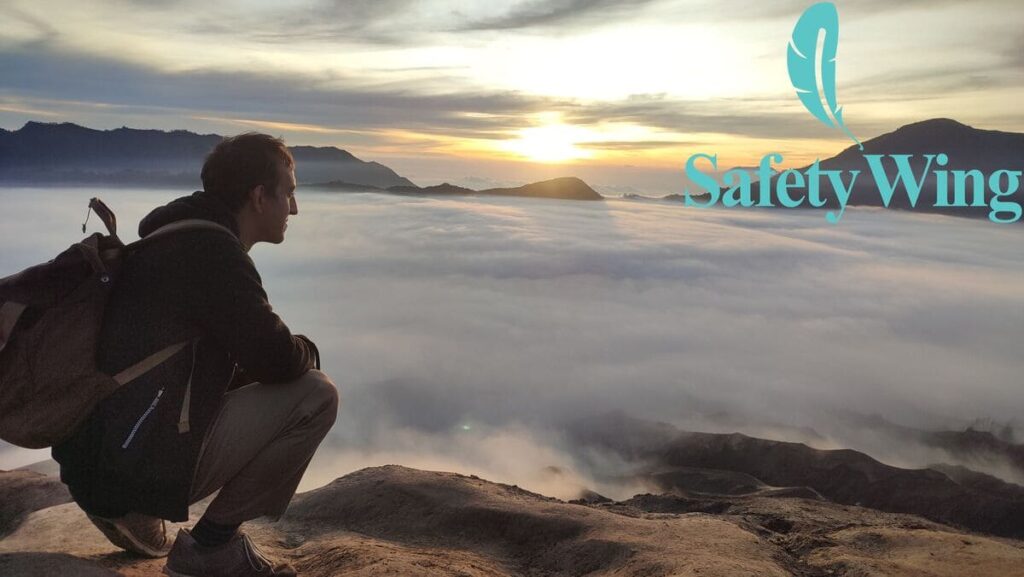
In the following lines, I will tell you what I like about SafetyWing and what its biggest flaws are, so you can decide if it’s suitable for you too.
What is SafetyWing?
SafetyWing is a travel medical insurance provider launched in 2018, designed with nomads and travelers in mind.
The first time I used them, I was looking for an insurance policy that I could purchase while already traveling. I considered the 2 USD per day a good price, and thus, SafetyWing has been my go-to choice while ‘gallivanting’ ever since.
SafetyWing’s mission is to provide affordable, flexible, and borderless insurance. The last one really resonates with me, having been backpacking across countries pretty much constantly since 2022. For a short trip, I would buy a fixed-term policy, but when traveling for an extended period of time, I opt for the monthly subscription.
It currently offers two plans:
- Essential: Covers the basics, most importantly emergency medical, for peace of mind. Costs a little more than 2 USD per day if you’re under 39.
- Complete: A more thorough healthcare + travel coverage for nomads who want a comprehensive policy that includes routine checks, mental health support, maternity, etc. Costs almost triple per month and requires a one-year commitment.
Do you even need insurance?
I am not your mother, let’s start with that.
But I am an economist by education, so here’s what I know as far as ultimate rationality is concerned. Also, nothing I say should be construed as a recommendation, and I take no responsibility for outdated or incorrect information. Use your own discretion, please.
The insurance business is in it to make a profit. Insurance companies are not charities or NGOs. Their primary goal is to, when you draw the line, make money.
Which also means that, on average, we consumers “lose” money by buying insurance.
I’ve just made it sound like insurance is a scam.
There’s one more detail that is super important – people are risk-averse.
We don’t like risks where the consequences of an event with even a minuscule possibility are catastrophic. This is a well-documented characteristic that applies to most people.
Hence, why we buy insurance. Had human beings been purely rationalistic, what economists call “homo economicus”, insurance markets wouldn’t exist.
Insurance is a service we are willing to pay for, even if we don’t actually want to make any claims (because this means something bad has happened). So it’s not exactly a “loss” that we incur, but a payment for a service.
In the context of travel, not having insurance is okay… until it isn’t. Accidents happen, shit hits the fan in some way all the time. While it’s easy to think it won’t be you, it may as well be.
Insurance is the price we pay to be at peace, even if nothing bad ever happens.
To know that you won’t have to pay thousands out of pocket for the unavoidable crap that life has thrown at you.
Backpacking includes millions of minuscule instances when something unexpected can happen, and honestly, it’s better to be prepared. See, I am appealing to your risk-averse self, and I hope it’s working.
Claims, horror stories, scams, and how to handle it all
Insurance companies will stick to the letter of the policy when it’s time to make a claim. They are not your friends and frankly, not your mother either.
They are fair but legalistic.
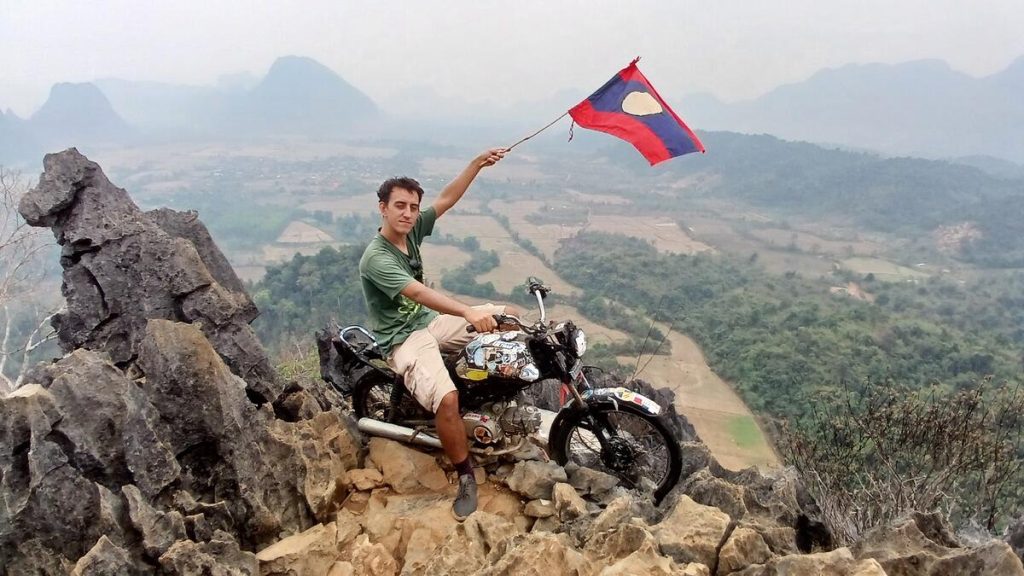
You can easily find negative reviews about any insurance, including SafetyWing. They are often what appear to be horror stories, but it’s usually just a mismatch between expectation and policy coverage.
Yes, insurance companies will make triple-sure that your claim is covered before paying out. They won’t pay for pre-existing conditions, for example, some of which you may not even realize fall into this category unless you read the policy in detail or ask explicitly beforehand.
Is that a con? I don’t think so – it’s just a standard market practice in a field where fraud would be way too rampant otherwise.
So, to minimize the chances of having to write a negative review yourself:
- Read the policy coverage carefully. Yes, it’s long and detailed, has a ton of exclusions, is not a fun read, but it’s the single most important thing you can do concerning insurance.
- Keep receipts, medical notes, bills, basically a paper trail about everything.
- Ask questions when unsure. Online support is available 24/7.
- Be honest, but succinct. Answer questions truthfully, but no need for yapping.
What SafetyWing covers and what it doesn’t
Concerning insurance, it is paramount that you know and understand what exactly is included and what isn’t.
The coverage section can also be convoluted and overwhelming. You must do your due diligence before buying any insurance, so you don’t end up in a situation where you think you’re covered but are not. Because when something like this happens, it’s horrible.
I assume most backpackers will be more interested in the Nomad Insurance Essential plan as it’s designed primarily for emergency and unforeseen medical expenses. It’s also the one I use when traveling. It is great as a temporary cover, but should not be used as ongoing health insurance.
The Nomad Insurance Complete, on the other hand, is a much more comprehensive plan with a higher price tag and a more thorough coverage.
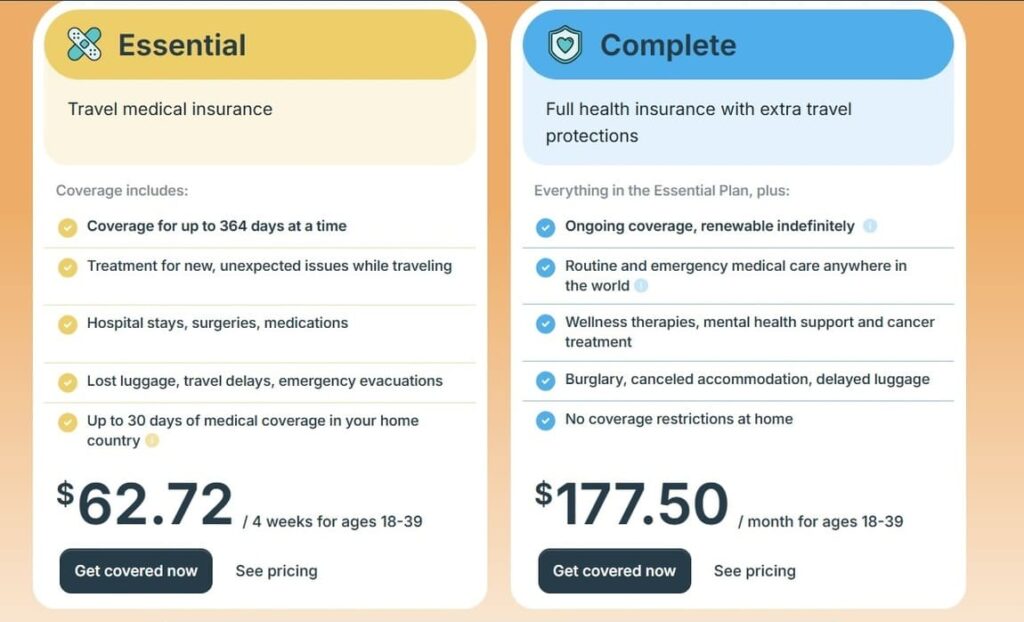
Below, you can find a summary of what the Essential plan covers:
Nomad Insurance Essential Coverage
| COVERED | NOT COVERED |
|---|---|
| + Medical treatment and hospitalization up to 250.000 USD. | – Pre-existing conditions, regular, routine check-ups, and preventive care. |
| + Repatriation | – Traveling to Belarus, Cuba, Iran, North Korea, Puerto Rico, Russia, Syria, or Ukraine. Coverage in the USA requires an add-on, which is not available to US residents (who are covered only up to 15 days at home). |
| + Injuries from leisure sports and activities up to 250.000 USD. Adventure sports require an add-on. | – Off-path, off-trail, professional sports, anything you’re paid to do, and a bunch of extra dangerous activities like cliff jumping and running with bulls (sorry, Pamplona-lovers). |
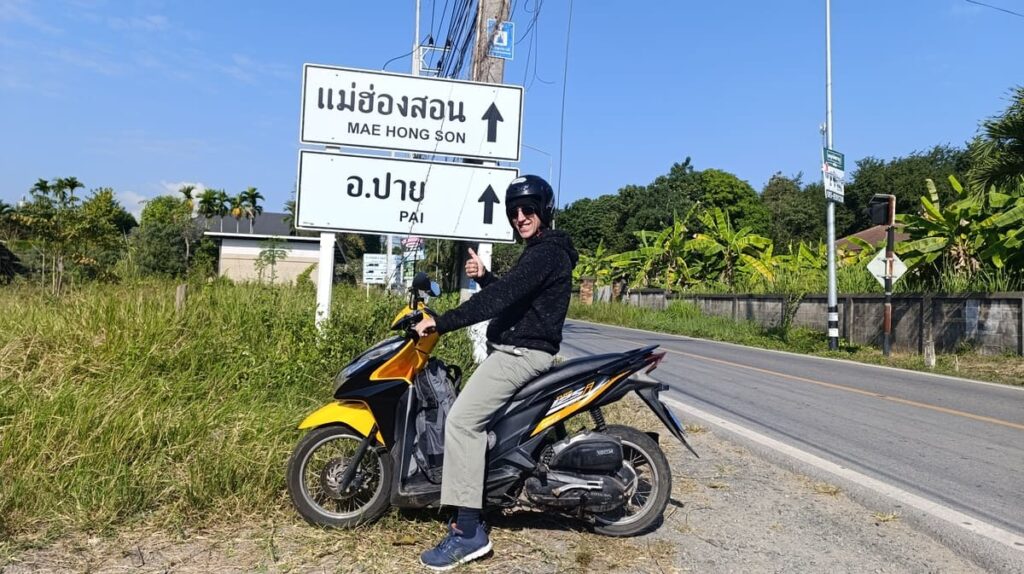
| + Motorcycle accidents, as long as the bike is under 50cc, and you’re properly licensed. | – An add-on is required when driving stronger motorcycles (>50cc). In Southeast Asia, pretty much all bikes are 90cc or more, so you need the add-on to be covered on any of the famous motorcycle loops. |
| + If you need to return home due to a death in the family (not a grandparent, though) or home destruction by fire or the weather. | – Search and rescue. |
| + Reimbursement for incurred costs such as meals, lounge pass, and accommodation, due to travel delays or cancellations. | – Cancer treatments. |
| + Evacuation from local unrest where a travel warning was issued while you were already there. | – Maternity care. |
| + Stolen passport or travel visa. | – Wellness and complementary therapies. |
| + Lost luggage on a flight/cruise. | – People aged 70 years or older. |
Add-ons
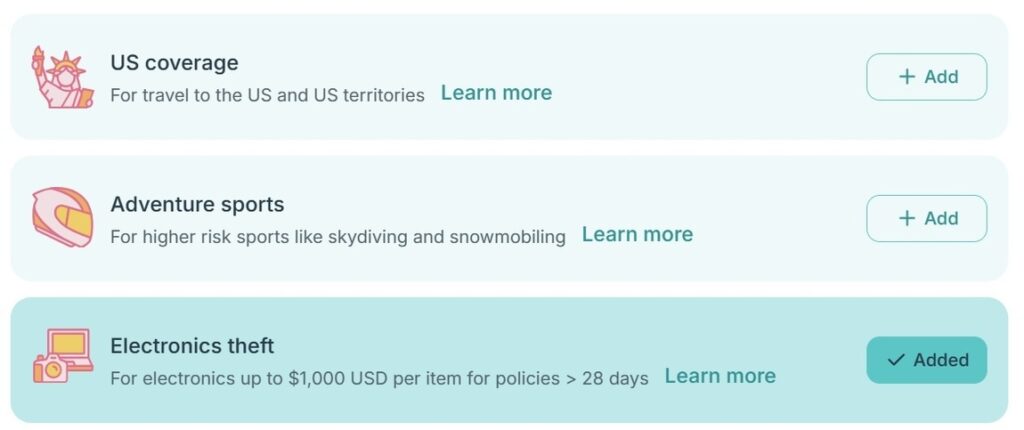
The base Essential plan has an option for 3 add-ons for extra coverage. These are not for everyone, so you may find them either redundant or useful.
- US Coverage: You only need that if you’re traveling to the USA. The country is notorious for its high healthcare costs, which is why insurance there costs extra. This add-on costs 2 USD per day (on top of the regular plan price). It’s best to enable it for your trip to the US, then disable the add-on after you leave.
- Adventure Sports: Many sports are covered without the add-on, but you need it for higher-risk activities such as boxing, parachuting, martial arts, karting, etc. Costs 10 USD per 28 days.
- Electronics Theft: Quite useful for digital nomads and videographers who carry a lot of equipment, including laptops, tablets, cameras, etc. Note that you must submit proof of ownership (receipt works), and you will be reimbursed up to 1000 USD per item (up to 3000 USD per insurance period), based on its age and original value.
Why SafetyWing rocks!
One of the best things about SafetyWing is that it can be activated even if you’re already outside of your home country.
Most insurance providers in my country require that I purchase a policy before leaving and that it has a set return date. When I left home in 2022 to go backpacking without a planned return, this was not an option. SafetyWing’s subscription model made a lot of sense.
Another massive benefit is that they removed the deductible a few years ago. Today, Nomad Insurance does not have a deductible on either plan! This means that you don’t need to pay anything out of pocket when you successfully claim from your policy.
For me, these 2 reasons plus the fact that it’s one of the cheapest options on the market make SafetyWing a no-brainer for backpackers.
It’s also not just me – about 75% of all reviews on SafetyWing’s Trustpilot are 5/5 stars.
There are several other perks, most notably:
- Their online assistance is 24/7, and it’s NOT one of those annoying AI bots.
- Submitting a claim takes 5 minutes, tops, and it’s all online.
- The average claim process is under 3 days.
SafetyWing Cons
SafetyWing has the same cons as any other insurance – they are a business and not a charity. I covered that in the article already, so I won’t dwell further.
Basically, you can expect differences in coverage between companies, but the way it’s applied will be mostly the same.
A few drawbacks that SafetyWing’s Nomad Insurance Essential plan specifically has that come to mind are:
- Costs more the older you are (standard industry practice). You can’t use the Essential plan if you’re older than 69.
- Limited coverage for electronics.
- Limited trip cancellation coverage. Pre-departure trip cancellation is not included at all.
- Home coverage is limited to 30 days (15 in the USA) within any 90 days.
- Does not cover personal liability when renting a car. If you damage the vehicle, SafetyWing won’t cover you. You can purchase this type of insurance from the rental car company instead.
- Won’t cover you in a few “naughty” countries to comply with international sanctions.
TL;DR: Is SafetyWing suitable for backpackers?
Overall, I think Safetywing is a great travel medical insurance for backpackers. Most of us are under 40, which means that SafetyWing is quite affordable, too. Even for the older folk, I have yet to come across a cheaper option for the same coverage.
The Nomad Insurance Essential covers unexpected accidents and gives you peace of mind to focus on the experiences themselves.
And if you “evolve” into a digital nomad down the road, the Nomad Insurance Complete is a suitable option for comprehensive insurance without having a clear home base.
If traveling is a lifestyle, travel medical insurance is one of the best investments you can make.