8 Common Scams in Morocco to Watch Out For
This post may contain affiliate links. If you make a purchase using one of these links, I may receive a small reward at no extra cost to you. See my Disclosure Policy for more information.
Morocco has become somewhat synonymous with tourist scams in recent years.
I had a similar preconception, but after I traveled throughout Morocco for a week, my opinion changed dramatically: Morocco is generally safe, and locals are mostly kind, helpful, and good-intentioned.
Scams do happen in Morocco, as they do anywhere else with a sizable tourism industry. But it’s nowhere as widespread as some may have you believe.
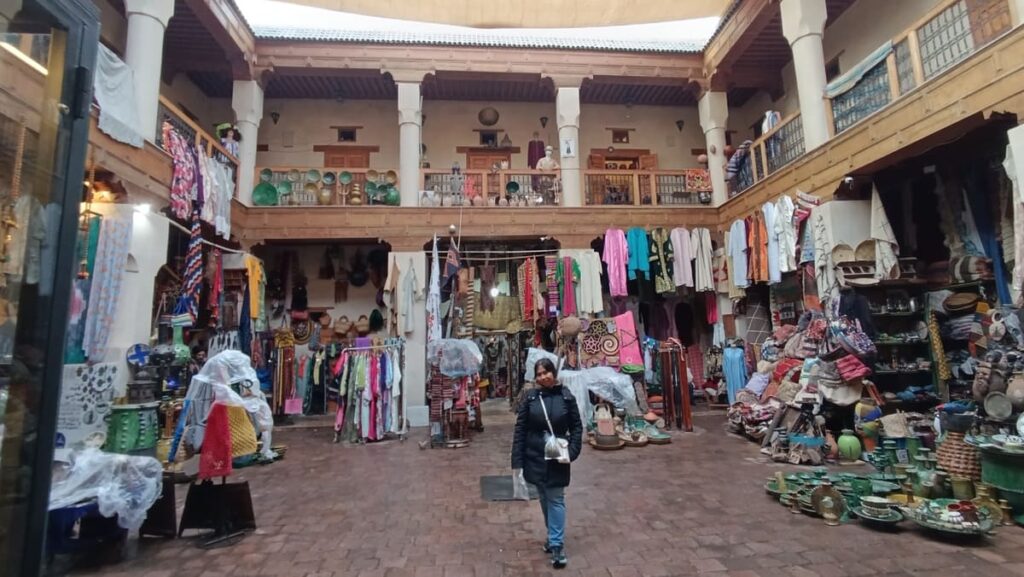
Moreover, scam is a pretty strong word that travelers (myself, guiltily, included) use willy-nilly.
For example, you are very likely to overpay for pretty much everything as a tourist, but this isn’t a scam per se – you have just agreed to a higher price because you didn’t know better. A consenting transaction can be considered a rip-off but isn’t fraud (i.e., a scam).
Being tricked, manipulated, lied to, or swindled all fall somewhere on the spectrum between rip-offs and scams. But this isn’t about the technicalities of word definitions.
You want to know how to avoid being scammed in Morocco, so here is what to keep your eyes peeled for.
1. “It’s closed”, aka the unwanted guide
This scam happens in more touristy areas, like the Marrakech or Fes medinas, and can go two main ways.
In any case, it begins with a local claiming that a popular attraction in the city, or an alley in the medina, or a souk is closed. If this piques your interest, he (and it’s always a he) will begin guiding you to another location.
The more sinister version of this scam is when he walks you a few blocks and just straight up demands money for his tour guide services.
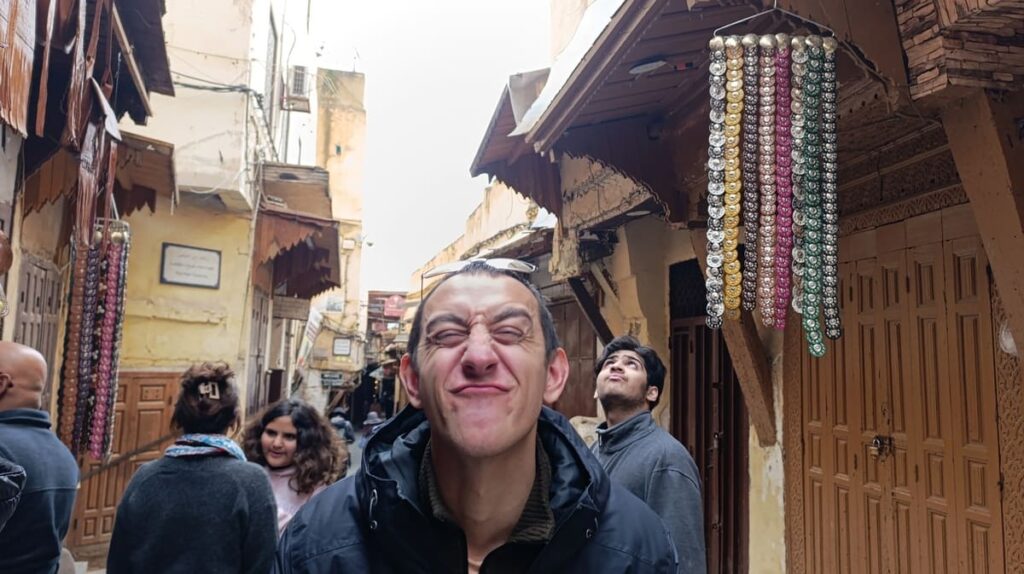
More often, though, he will lead you to a restaurant/shop where they will overcharge you shamelessly, and he will get a commission. And he may ask for his unwarranted tour guide wage anyway.
It happened more than a few times to me in Fes. A street/alley in the medina was always ostensibly closed and yet turned out open at the end.
How to counter this scam
Some of those unsolicited guides are actually pretty nice and mean no harm – just genuinely want to help you find your way, no tip expected.
Unfortunately, a few bad ones spoil the punch, so it’s best to be aware when someone offers to guide you in the city.
Clearly state that you are not lost and you don’t need a guide. If the street/attraction is actually closed, no big deal; a walk in the medina is an experience in itself anyway.
And if you actually need/want a guide in Morocco, book one via GetYourGuide. You will get a knowledgeable local guide who isn’t out there to scam you.
2. Inflated prices and sales pitches
Not a scam per se (see the intro), but as a tourist, you will end up paying more for nearly everything.
You should consider this the cost of traveling, but that doesn’t mean you should open your wallet for everyone to take as much as they want.
Au contraire: While in Morocco, bargain for everything. Just assume you are asked to pay more than the usual and ask for discounts. Always.
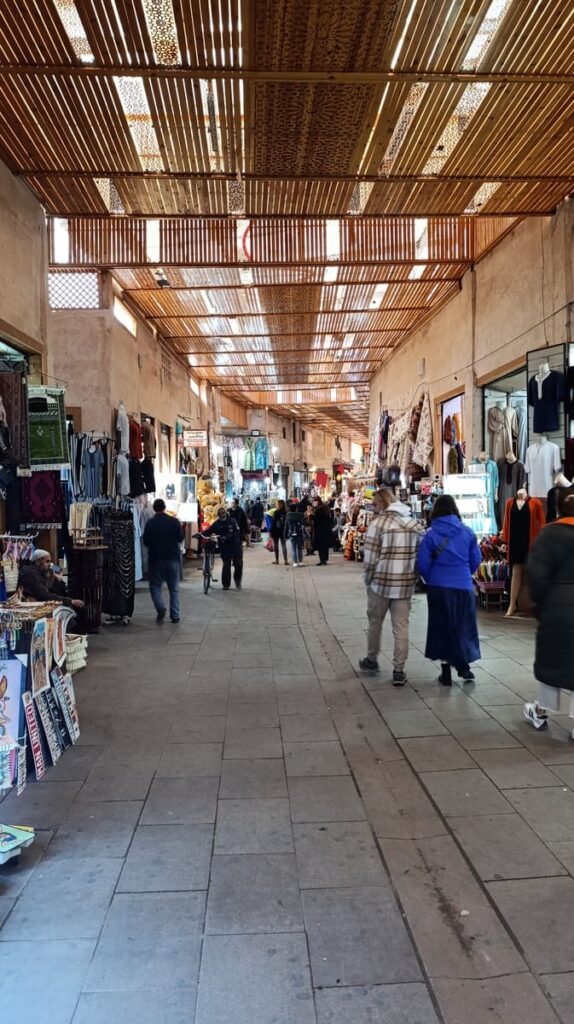
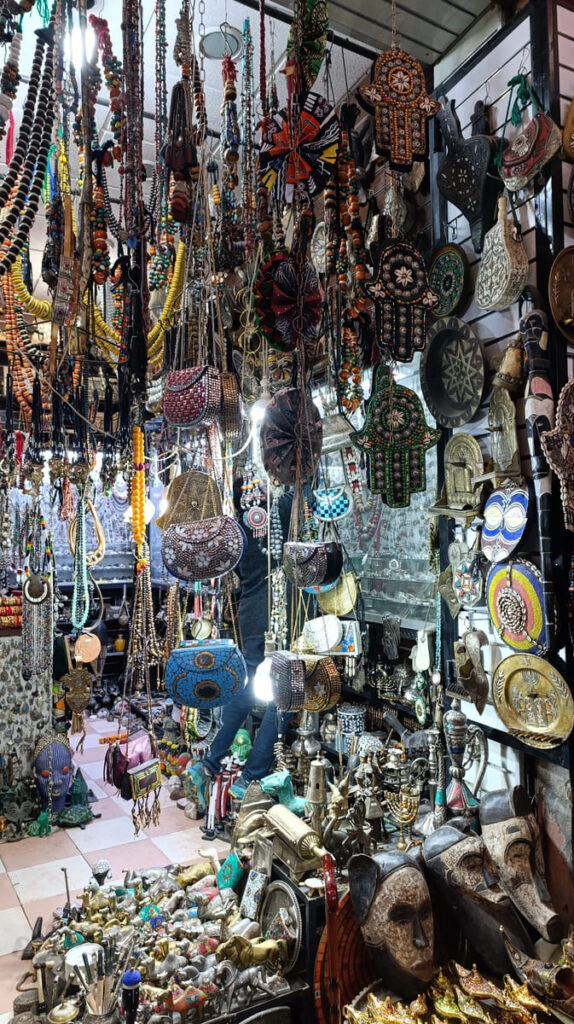
Even knowing that, I still fell for it several times.
For example, in Marrakech, this very friendly spice vendor explained the use of nearly everything he had in his store. I am talking spices, roots, powders, balms, etc. We felt like we had to buy something.
It wasn’t like he pressured us, not at all. But it’s the social contract, right?
So we asked about the price of tea. 1 dh (0.1 EUR) per gram, he said, and showed us the sticker on the back of the box. Seemed legit. We bought a little.
A few minutes later, it struck me – this comes to about 100 EUR per kilogram of tea. This is several times the retail price. Lesson learned…again.
We also paid more than for nearly everything in Morocco, even after haggling. If the markup is reasonable, it’s not a big deal.
How to counter this scam
In Morocco, commerce is king. Prices are flexible and depend on “vibes“, among other factors. Take the little higher price as your tourist tax.
Perhaps the need for bargaining is not really a scam, but some will try to take advantage of you. Get to know the fair prices of certain things before you hit the medina. Once in the souk, assume you are being overcharged and haggle, haggle, haggle!
3. Fake goods
Unfortunately, much of the merchandise sold at Morocco’s markets and souks is fake.
Who knows exactly what proportion is fake – could be 10%, could be as high as 90%. Anything from argan oil and spices (saffron nearly always) to rugs, leather goods, and pottery.
Argan oil is often diluted, leather may be artificial, rugs may be machine-made (not century-old, hand-made relics), etc.
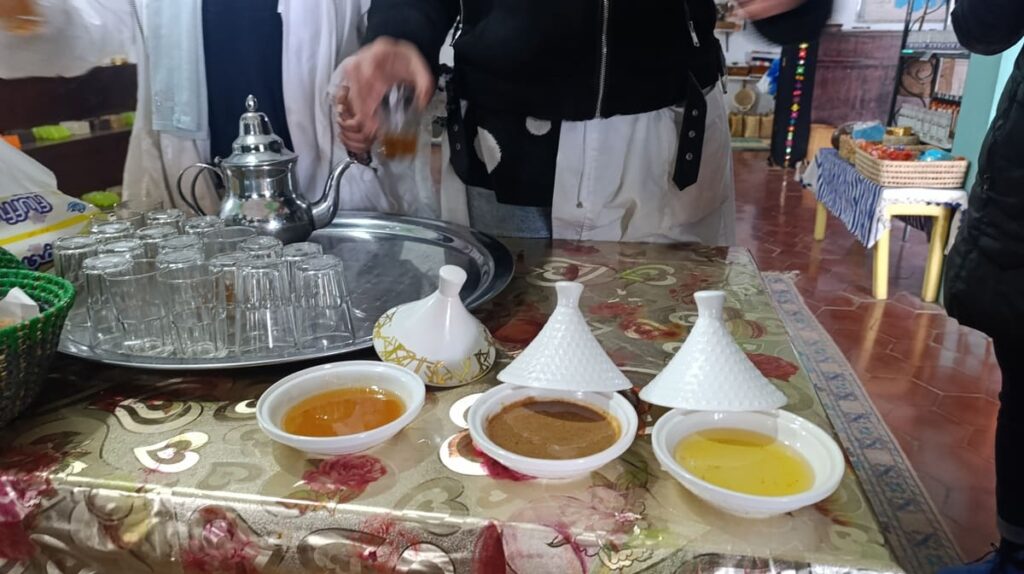
You’ll also see dinosaur and shark teeth, sea fossils, and gem deposits – all of which are universally fake.
Telling fake from real takes an extraordinary amount of expertise, which, for a short trip, is unfeasible to acquire.
Just remember that if the price is too good to be true, then it probably isn’t. But also that if a merchant is trying to aggressively sell the item and exaggerates its characteristics, it’s likely fake.
How to counter this scam
Do some research about the item you want to buy before you hit the souk. Learn the common ways to tell fake from real for whatever you’re interested in and be prepared at the market.
It’s as simple as that. Well, not really simple, but at least you won’t be totally clueless.
4. Taking pictures of animals (monkeys, cobras, etc)
If you see a man holding/handling any type of animal in a public square, you’d better stay away and keep your camera/phone away.
In Jemaa el-Fnaa, Marrakech’s main square, among other places across Morocco, men display cobras on carpets and monkeys in chains with the hopes that tourists will show interest in them.
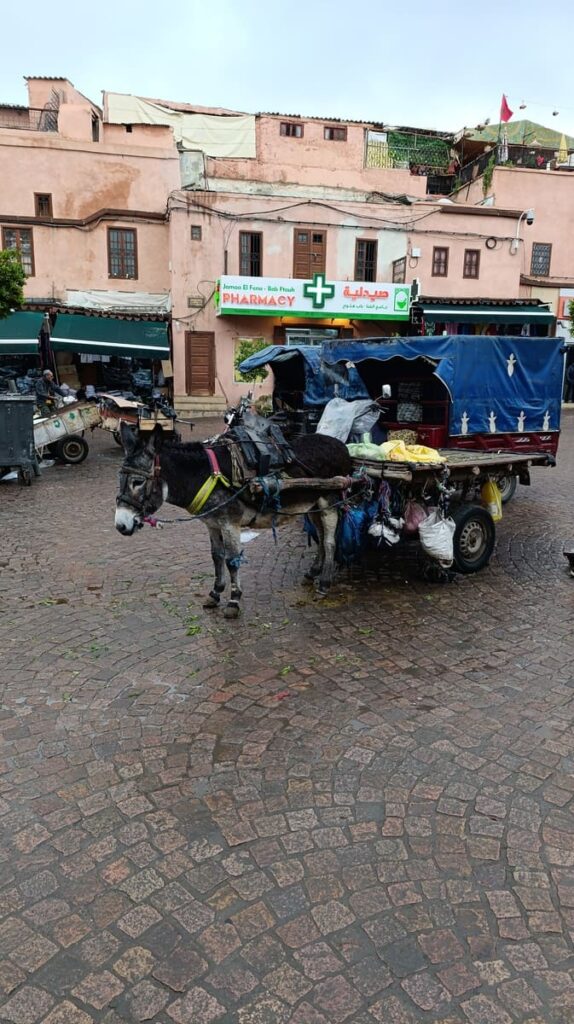
If you do, you will have to pay for it. It goes in 2 main ways:
- If you go closer, they may put the monkey on your shoulder, then demand money to take it off you. They may also take a picture of you with it and ask for some cash. It’s not a little either – 100-200 MAD (10-20 EUR) for a pic with a captive monkey is daylight robbery.
- If you take a picture from afar, the locals will rush you to demand compensation.
How to counter this scam
Observe from afar and don’t take pictures of animals, even from a distance.
If you actually want a picture with whatever animal it is (monkeys and cobras, usually), negotiate beforehand, from a safe distance of a few meters. Although given the horrible conditions they are in, I’d suggest you reconsider altogether.
5. Taxis and InDrive
Taxis are a common source of frustration and other negative emotions. Most cities in Morocco have public transportation, so you can avoid them for the most part, but not always.
For example, arriving at a Moroccan airport at night will require a taxi ride to your riad. And they are often out to get the most money out of you.
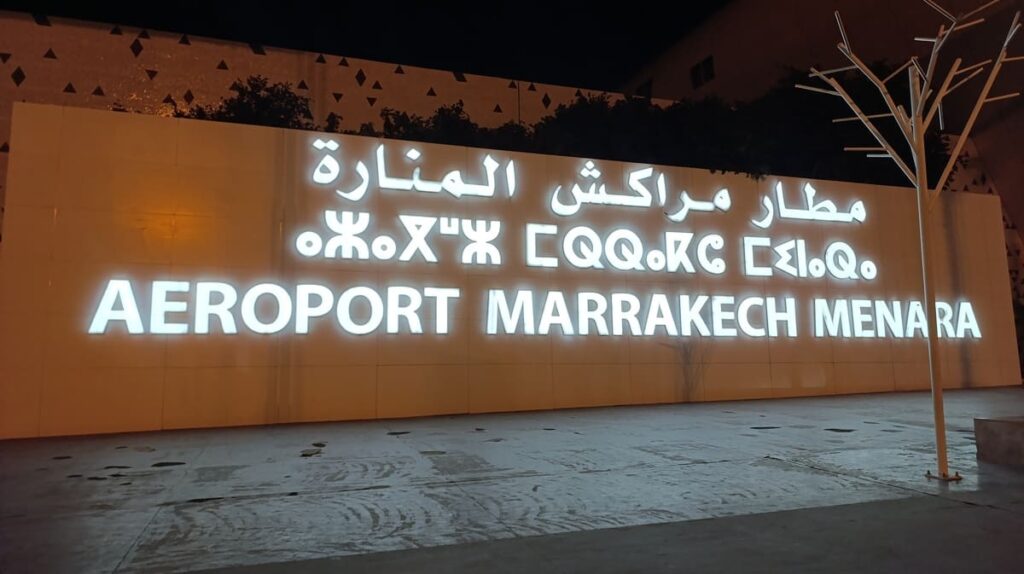
They will refuse to use the meter and/or ask for triple the standard amount.
You may have heard of InDrive, the local ride-sharing app. However, it is technically illegal in Morocco, and since airports are heavily monitored by both the police and the local taxi mafia, picking up passengers there (even outside the airport area) becomes a cat-and-mouse game.
This actually happened to us at Fes Airport. I didn’t like the price the airport taxi drivers quoted, so we walked to the roundabout outside the airport and ordered an InDrive ride (mind you, the price was 1/3 of the quoted one, although I was ready to tip well).
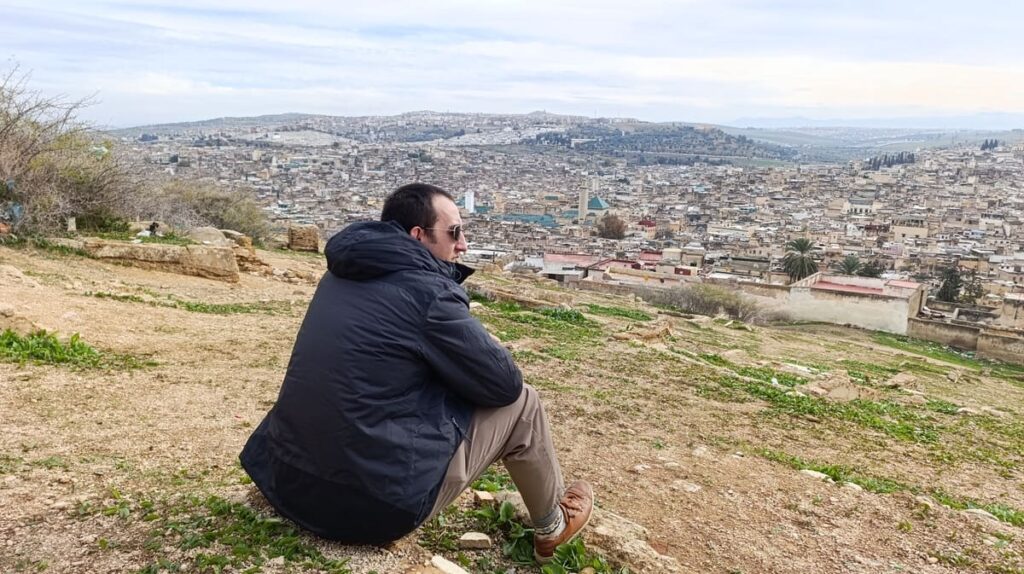
The poor driver came to the airport only to be spooked/chased away by the airport taxi mafia. We ended up taking the regular taxi.
Similarly, we also had to take a taxi to the train station in Fes. Even though locals pay around 10 MAD for a ride between the medina and the train station, the taxi driver asked for 30. After a bit of negotiating, we got the price down to 20 MAD, and all 4 of us hopped into a petit taxi, which normally has a capacity of 3 passengers.
On arrival, he demanded 20 MAD more, claiming that we would’ve had to take 2 taxis otherwise – true, but also not what we agreed. I yielded, seeking no further arguments.
How to counter this scam
Always ask to use the meter if one is available. Petit (small) taxis are required to have them. Note that they are forbidden from leaving the city, though. Grand (large) taxis (>3 passengers) do not have meters and use fixed fares.
Which brings me to advice #2: research the fair fare before you start negotiating. Petit taxis in particular are much cheaper than you think (around 10 MAD for a 3-4 km ride).
At any airport, check if there is a licensed booth that organizes taxi rides. Marrakech Airport has one, but I didn’t see one at Fes Airport. You can pay at the booth, depending on the size of your group and the destination, and then present the receipt to the taxi driver – no extra charges. While still quite expensive, at least you won’t have to argue.
6. Henna artists
This usually happens at Jemaa El-Fnaa in Marrakech, but it can occur anywhere.
In all fairness, I didn’t fall victim to this scam, but I saw the henna ladies.
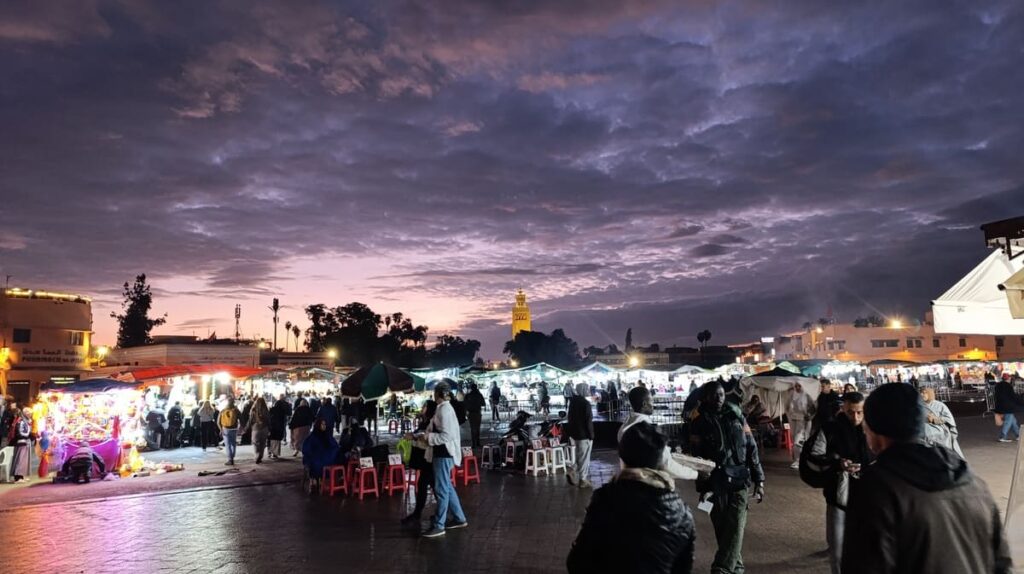
If you walk by them, a henna artist may “accidentally” spill some ink on your arm and then offer to fix it. She will look apologetic, even offer to do a full henna tattoo for free.
If you agree, the tattoo will be rushed, and she will nevertheless ask for money – usually an exorbitant amount in the order of 200-300 MAD (20-30 EUR).
Moreover, it is known that they don’t even use the proper henna ink, instead using something called black ink, which is reportedly dangerous and a health hazard. Double whammy.
How to counter this scam
Just don’t go close to the henna ladies in Jemaa El-Fnaa, Marrakech.
If some ink reaches your arm, just ignore any offers to fix it, wipe it off ASAP with a napkin, and move on.
The fair price for a genuine henna tattoo is around 50 for small ones on the back of your hand, but can be up to 250 for larger designs that cover your entire arm/leg.
7. Buying hashish
As you’re walking the medina, a young man may offer you some hashish, or kif – a cannabis concentrate product.
While both illegal and haram, it is not too difficult to find in Morocco.
If you are of the adventurous kind and buy some, heck, even smoke some with the seller (an authentic experience, am I right?), there is a real chance that a policeman pays you a visit.
The policeman and the dealer and both in on the scam. The former will suggest that you pay a huge bribe so he doesn’t have to arrest you. Money can solve all problems in Morocco.
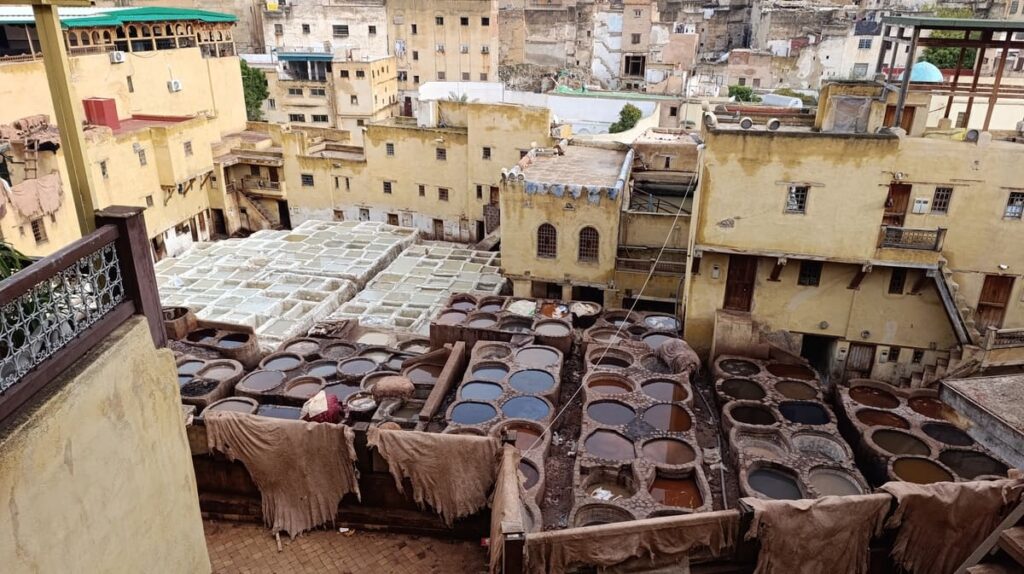
I was offered hashish in Fes – the vendor nonchalantly added it to all the other items he advertised verbally. I believe it happens in more cities, too.
How to counter this scam
Don’t buy drugs.
In Morocco, drug possession and use are punished severely. If caught, you’d be happy to pay a bribe to get away, trust me.
And if I were you, I’d stay away from all vendors that offer drugs, too.
8. Fake beggars
You see a cripple sitting on the side of the road, begging. You get empathetic, perhaps a little sad. You remember how much poorer Morocco is compared to your country (I assume, but given you can afford to travel, probably true). You give a few dirhams.
Later, you see the same cripple walk the street, no disability in sight.
While I hadn’t given any money, I saw how a crippled beggar transformed into a regular citizen in a matter of seconds.
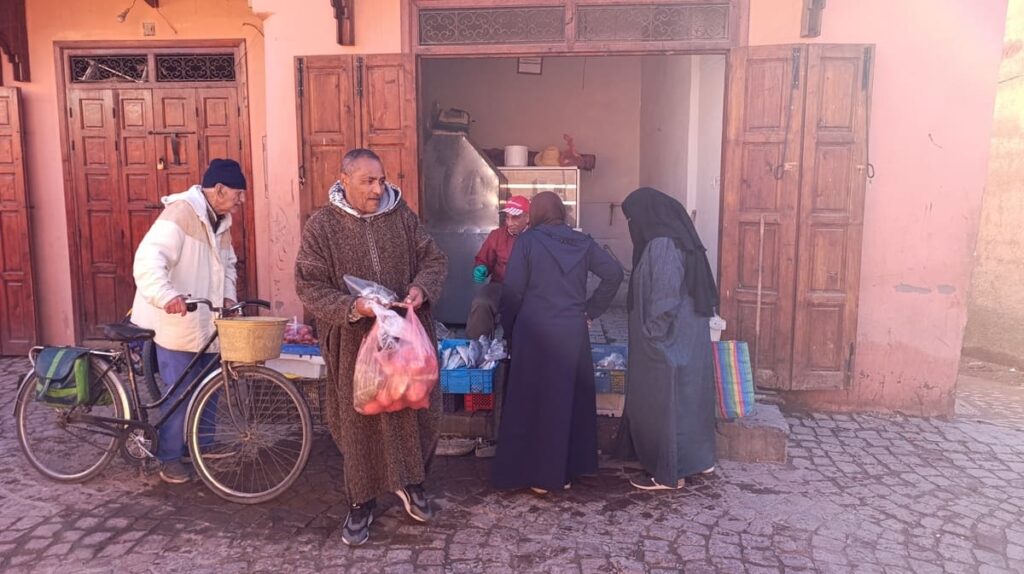
I have also heard of “babies for rent,” where beggars, usually women, rent someone else’s baby for the day to make them look more pitiful.
While not exactly scams, these are deceitful and will leave a sour taste in your (otherwise charitable) mouth.
How to counter this scam
Don’t give money to beggars. If you want to do good, think of your regular purchase decisions in Morocco as good enough. At least in this case.
Or forget you read about this and do as you please. Not the worst thing in the world either.
How common are scams in Morocco, really?
Actually, not that common!
Despite what I may have had you believe so far in the article, Morocco is a pretty safe country, and Moroccans are mostly honest.
If we take scams to be serious, deceitful, and/or dangerous frauds, then you are unlikely to be part of one while in Morocco.
If we take the expanded definition, where a scam is any situation in which you are made to unfairly (although not necessarily unknowingly) overpay, then you are pretty much guaranteed to be on the receiving end of one.
We weren’t seriously scammed in Morocco, but we overpaid in numerous cases.
What to do if you are the victim of a scam?
In most cases, be thankful you are still alive, consider the money lost as the cost of traveling, and cherish the new fun story you can now tell your friends.
If you believe you were the victim of a scam, or if anyone is giving you a hard time, contact the Moroccan tourist police at 05 24 38 46 01 or 05 24 88 86 80.
Emergency numbers in Morocco
Apart from the tourist police numbers listed above, other handy emergency numbers in Morocco include:
- 19, 190, or 112 for the Police.
- 177 for the Gendarmerie (outside of cities).
- 15, 150, or 112 for an Ambulance/Medical Assistance.
- 15 for the Fire Brigade.
- 177 for Roadside Assistance.
And remember – if you get in real trouble, always call your embassy as soon as possible.