
3 Days in Yogyakarta Itinerary: The Perfect First-Timer Route
This post may contain affiliate links. If you make a purchase using one of these links, I may receive a small reward at no extra cost to you. See my Disclosure Policy for more information.
Yogyakarta (often called Jogja) is one of the most rewarding places to visit in Indonesia. It combines ancient temples, royal Javanese culture, and numerous opportunities for unique day trip outdoor adventures.
If you only have 3 days in Yogyakarta, this itinerary will help you see the essentials without wasting time -including Borobudur, Prambanan, the Kraton, Taman Sari, Malioboro Street, and trips like Mount Merapi, Goa Jomblang, and Timang Beach.
This is a complete day-by-day plan based on my real travel experience. I first went to Jogja (Yogyakarta’s nickname) as a tourist, returned as a traveler 3 years later, and then stayed for 8 months. I’ve been back to the city several times since.
It is designed for first-time visitors who want both structure and flexibility. Are 3 days enough? Most certainly not. But if that’s all you have, this 3-day itinerary in Yogyakarta is for you.
The 3 days in Yogyakarta at a Glance
- Day 1: Culture – the Cosmological axis, the Kraton, Taman Sari, Malioboro, Pasar Beringharjo, Alun Alun Kidul, plus Kota Gede or Imogiri.
- Day 2: Temples – Borobudur, Prambanan, plus a choice of several other ancient temples and/or a quirky chicken-shaped house of prayer.
- Day 3: Adventure – A choice between a Jeep Safari on Mount Merapi, rappelling down Goa Jomblang cave, or a ride on the bizarre gondola at Timang Beach with a lobster for dinner. I will also show you how to pack all of those in one day!
What’s Special About Yogyakarta?
Yogyakarta is administratively a Special Region which is because it’s a special city and place to begin with.
It’s still a Sultanate ruled by the monarch Sultan Hamengkubuwono X.

More importantly, it’s the cradle of Javanese civilization with the highest concentration of ancient temples anywhere in Java.
Last but not least, Yogyakarta is a keeper of Islamic traditions on the island and a direct descendant of the Sultanate of Mataram – historically one of the great political entities in Java.
And if that doesn’t make it special, I don’t know what would!
Day 1: Cultural Yogyakarta
I will assume you have a full first day in Yogyakarta, although it’s often not the case. Your first day may be shorter if you arrive by train during the day. Worry not, Yogyakarta’s city center is not that big and is mostly walkable.
Morning → Cosmological Axis walk
Yogyakarta was on the UNESCO tentative list for years before finally being granted full status in September 2023. What exactly is the heritage site?
It’s a straight line of about 6 km. called The Cosmological Axis of Yogyakarta.
This axis connects three of the most important places for them: the Merapi Volcano, the Sultan’s Kraton, and the South Seas. Traditional Javanese cosmology places great importance on symbolic alignments between mountains, royal palaces, and the sea.
If you draw a straight line from Merapi’s crater down to the beach, it will run through Malioboro, the Kraton Palace, both public squares (Alun-alun), and a few arch gates that mark important entrances.
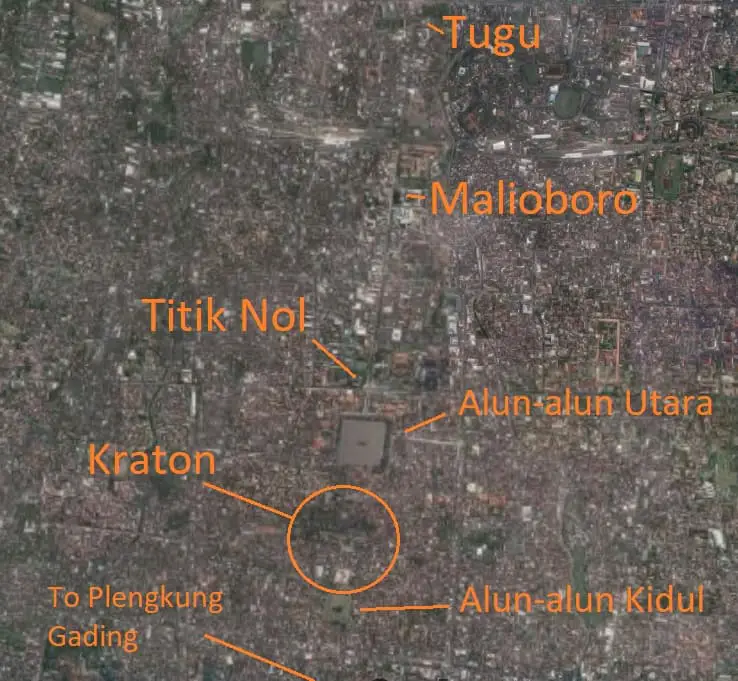
Most foreigners stay around the Prawirotaman area. If you do too, start your morning from Panggung Krapyak, the south gate of the Cosmological axis.
From there, stop at:
- Plengkung Gading: the gate to the Imperial City. Unfortunately walking on the walls is not possible anymore.
- Taman Sari: Not exactly on the Axis (about 300 meters to the west), but a fascinating place nonetheless. It was where the Sultans of ages past kept their concubines. Don’t miss the underground mosque!
- Kraton: The Royal Palace of Yogyakarta. It’s both an acting royal residence and a museum. Dancing and music performances are held daily.
- Alun-alun Utara: The northern public square; It’s also a good spot to stop for lunch.
The big intersection just north of Alun-alun Utara is called “Titik Nol” – the Zero Kilometer of Jogja. It is also the southern end of the famous Malioboro shopping street.
If you keep walking north along Malioboro (and by extension the Cosmological Axis), you will cross the railway tracks and then eventually reach the Tugu Monument – an ornate monument in the middle of a busy intersection marking the northern end of the Cosmological Axis.
Afternoon → Museum or market?
Depending on how much time you have and your interests, you may be able to visit one, two, three, or even more places in Yogyakarta.
I recommend these:
- Museum Sonobudoyo: Most of the Javanese written records are kept in this museum.
- Vredeburg Museum: A museum in a former Dutch fort dedicated to the Indonesian struggle for independence.
- Pasar Beringharjo: One of the biggest markets in Yogyakarta. Rebuilt in 1926 in Art Deco style. Go here to shop for batik or just to watch commerce happen in real-time.
Evening → Food + local vibe
You’ve ticked off the most important cultural places in Yogyakarta. Now what? Here are your options.
Kampungs
For an afternoon walk, I suggest you pick one of the many kampungs in Jogja: small neighborhoods with winding streets, kids flying kites, and their parents cooking or fishing in the rivers. I love kampungs.
Check out my favorite kampungs in Yogyakarta alongside other authentic things to do in Jogja.
Food
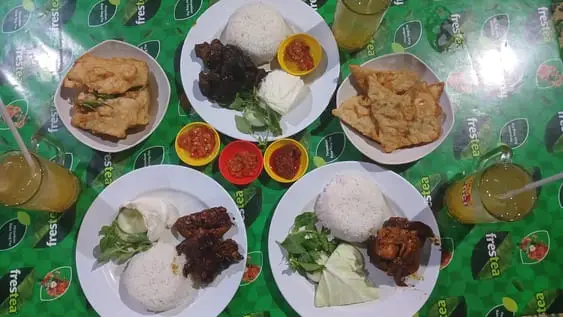
You can’t go to Yogyakarta and not experience the food culture!
Food is everywhere in Yogyakarta – warung at every corner, angkringan on every street. You don’t need to search a lot to find good food, but here are my top 10 places to eat in Jogja.
You can also visit the Alun-alun Kidul after dark and see how different and lively it becomes with the pedaled neon minibuses (called odong-odong) and the over 100 food stalls.

Check out these too:
- Best Indonesian street food snacks;
- Best Indonesian desserts.
Last but not least, if you’re into an organized food tour experience where a local will bring you to all the hidden food places and show you the best food to try, check out this street-food-tasting tour.
Day 2: Temples and Ancient History
On Day 2, I will bring you out of Yogyakarta to visit the two other UNESCO heritage sites: the temples Borobudur and Prambanan.
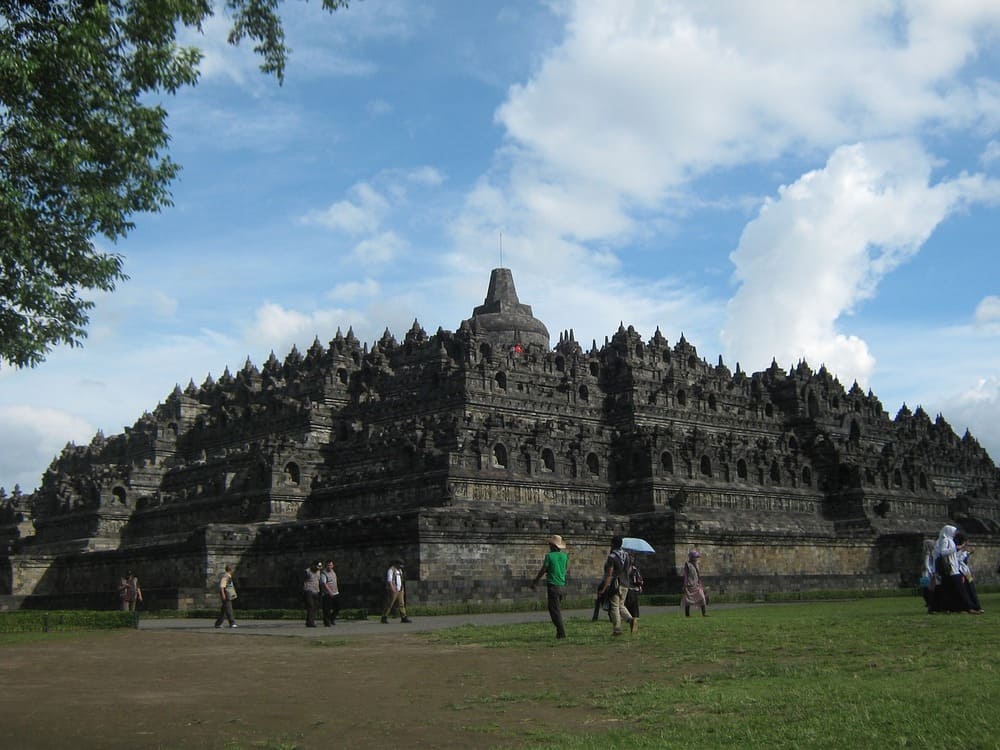
The ideal Day 2 involves an early wake-up with sunrise at or near Borobudur, a flexible program for midday (several other ancient temples), and sunset at Prambanan, followed by a Ramayana ballet performance near the temple grounds.
You can check these more detailed articles to help you plan:
- Sunrise at Borobudur
- Gereja Ayam: a chicken-shaped church that the founder claims isn’t a chicken and isn’t a church.
- Other ancient temples around Yogyakarta
- Sunset at Prambanan
- Ramayana Ballet
It feels like a long day, and it most certainly is packed with activities. I always advise first-timers to go to the temples on separate days if possible, but with just 3 days in Yogyakarta, it may be hard.
Thus, here is how to visit Borobudur and Prambanan in 1 day.
Day 3: Adventure!
The awesome thing about Yogyakarta is that after all the cultural and historical places and all the ancient temples, there are still ways to escape to nature and do something exciting. Very, very near!
There are beaches, volcanoes, caves, pine forests, lookouts, and rice fields to choose from. You can easily spend a full week in Yogyakarta and have exciting new places to visit every day.
How do I know? Well, I spent nearly 8 months and visited a new place every weekend!
Three experiences trump the others:
- A jeep ride on the slopes of Mount Merapi.
- Rappel down Goa Jomblang cave.
- Take the hand-drawn cable car on Timang Beach and have fresh lobsters for dinner.
Mount Merapi Jeep Safari
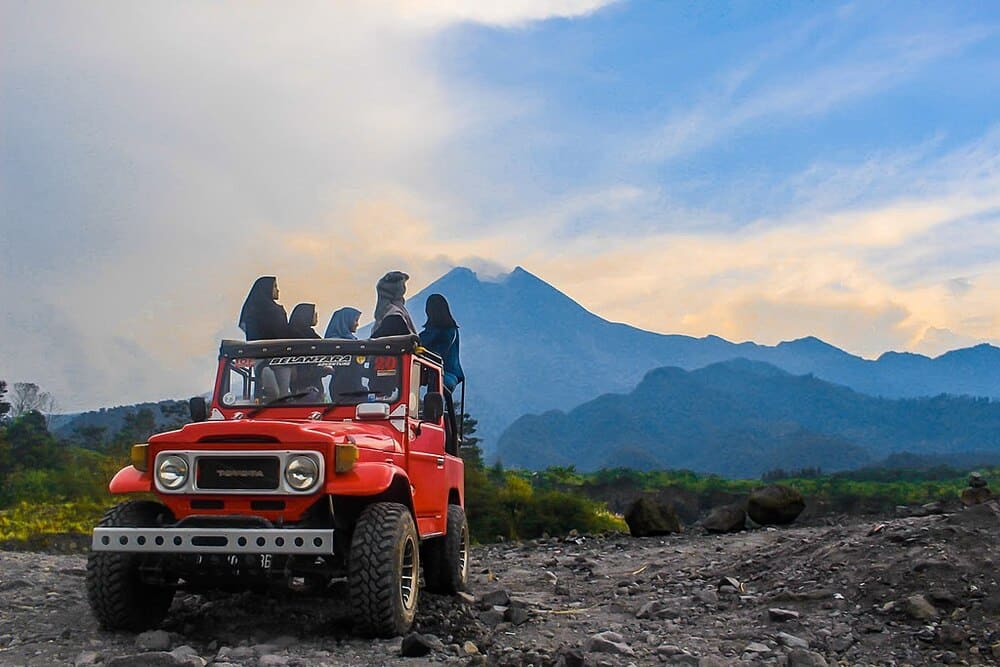
Mount Merapi is one of the most active volcanoes, not just in Indonesia but in the entire world!
How about a jeep ride up its slopes and the chance to see lava coming out of the crater? Yes, it is possible!
The jeep safari will bring you to a museum about Merapi and its eruptions over the years. You will visit villages directly affected by the eruptions in 2010. Your guide will bring you to the best Instagram spots for pictures and bragging rights.
Combine all of this with a lot of adrenaline from riding in an open-air 4×4 jeep!
It’s not something you can do independently; this tour will take care of everything, is extremely highly rated, and very affordable.
A Dive Inside Goa Jomblang
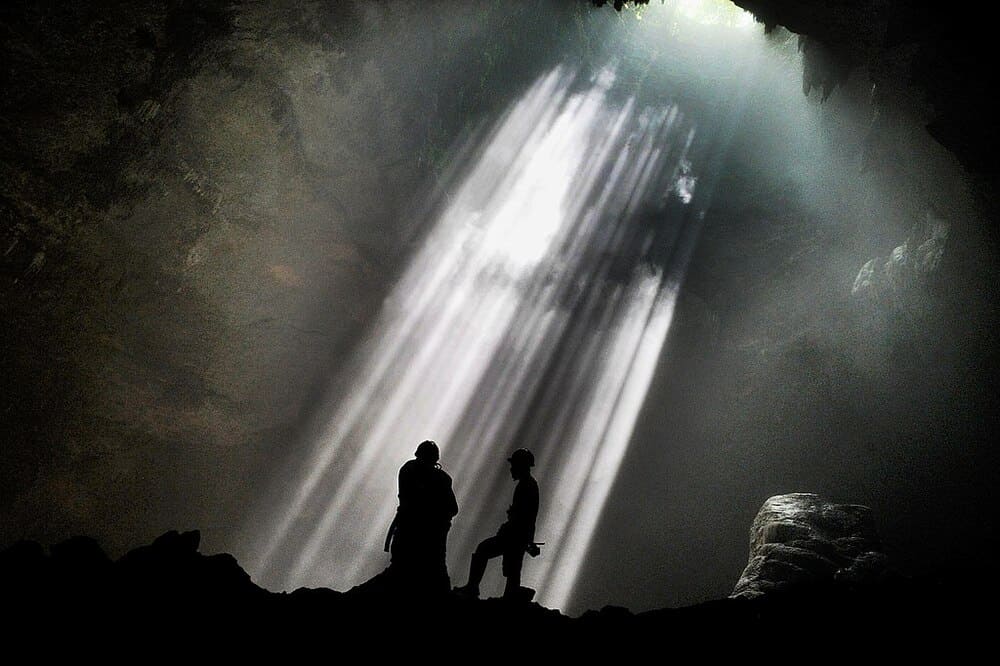
Goa Jomblang is not an ordinary cave – it’s a sinkhole that collapsed ages ago, forming a deep hole in the ground.
The bottom is so isolated that the vegetation there is markedly different from that above ground.
On the tour, you will rappel 90 meters down just before noon and do what locals call “the muddly walk” for 20-30 minutes. When you turn around to look up, you will be able to watch the sun shoot a single ray down.
Public transport to Jomblang Cave is tricky, and going down the cave requires prior booking, so an organized tour is strongly recommended.
Timang Beach
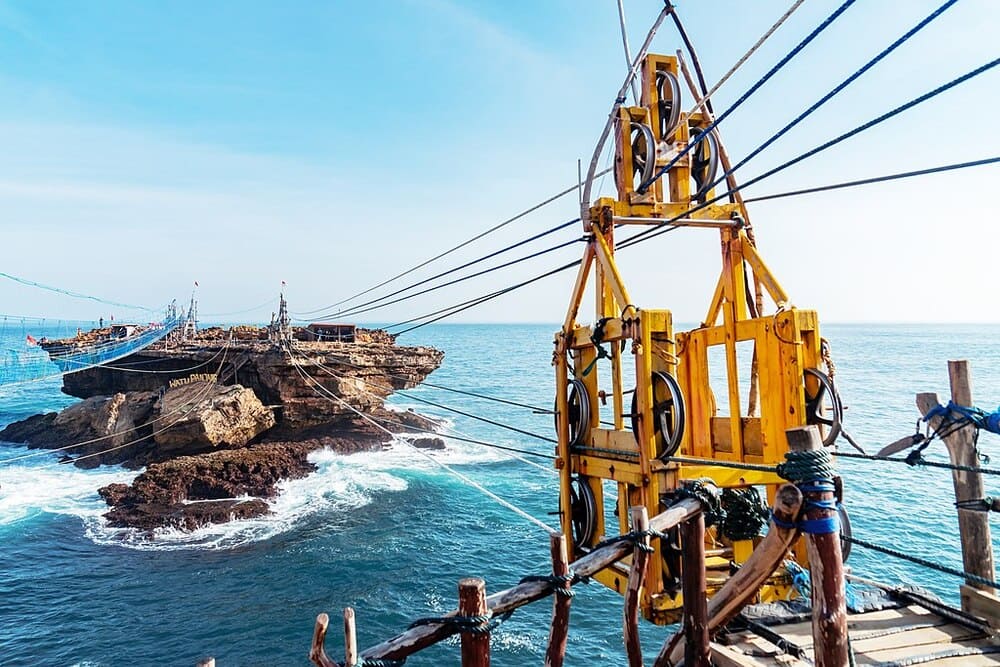
Out of the many beaches on Yogyakarta’s south coast, two stand out, but for different reasons.
The first one is Parangtritis Beach, considered to be the home of the legendary Kanjeng Ratu Kidul (the Queen of the South Seas). Remember how the Cosmological Axis ends at the South Seas? That’s why.
The second notable beach is Timang Beach. Here, the reason is not mythological but rather scenery-wise and a bit of engineering.
At Timang Beach, a hand-drawn gondola will take you to the nearby rocky island. It’s an odd place, unlike anything else I’ve seen.
To end the day, you can get some fresh lobster for dinner at the beach. If you’re lucky, you will see it caught right in front of you (and if you aren’t, it’s still the fresh catch of the day)!
Since Goa Jomblang is on the way from Yogyakarta, it makes sense to book a tour that combines the two. Coming solo is only viable with a scooter as there’s no public transport.
How about all 3 in one day?
Yes, that’s right! It is possible to do the Merapi Jeep Tour, Goa Jomblang, and Timang Beach in just 1 day. Since that’s all you have, this tour is PERFECT for travelers with limited time.
And given the number of places you will visit, the price is more than fair!
More Experiences in and around Yogyakarta
If the previous 3 didn’t appeal to you, I have this list of the best tours in Yogyakarta. They include both adrenaline-heavy adventures and slower-paced, creative activities, too.
How to Get Around Yogyakarta
Day 1 can be done on foot and with Grab/Gojek – the ride-hailing apps available in Indonesia.
Yogyakarta also has a limited public transportation network of bus lines, but for most first-timers, it’s not necessary to utilize and it’s not as reliable as ride-hailing (which is also quite cheap anyway).
Day 2 is easiest with a driver or as part of an organized tour. It is possible to visit both Borobudur and Prambanan using public/intercity transport, but it’s not the most convenient.
Day 3 usually requires a tour or private transport, as the natural attractions are relatively remote.
You can also do what I usually do – rent a scooter and have total freedom. While not essential, it is the most flexible. But if you are not confident riding one, better to stick to taxis, tours, and private drivers.
FAQ
Three days are enough to see the highlights of Yogyakarta, including the Kraton, Taman Sari, Borobudur, Prambanan, and one adventure activity, such as Mount Merapi or Goa Jomblang.
If you have more days, you can also explore lesser-known temples, traditional villages, beaches, and cultural sites that most visitors never see. Yogyakarta rewards slow travelers well.
The best time to visit Yogyakarta is during the dry season from May to September.
For most places, a little rain is not the end of the world, but certain outdoor attractions such as Mount Merapi, Timang Beach, and Goa Jomblang become harder to visit.
Learn more about what to expect during the rainy season in Java.
For first-time visitors, both areas are excellent choices.
Malioboro is more central and puts you within walking distance of many cultural attractions, shopping streets, and both train stations.
Prawirotaman is a bit trendier, a little quieter, and more geared towards tourists – there are plenty of cafés, restaurants, and guesthouses.
I personally prefer Prawirotaman, but Malioboro is slightly more convenient if you’re only spending 3 days in Yogyakarta.
Yogyakarta is one of the most affordable destinations in Indonesia.
A nice double room in a cute guesthouse costs around 10-20 EUR.
Meals cost as little as 1 EUR. Transport is also negligible – taxi rides in the city cost less than 2 EUR for a 5-kilometer ride.
Tours will probably be your largest expense, ranging between 20 and 50 EUR.
Where to Next?
If you’re going east, your next stops could be either:
If you’re going west, your next stops could be:
- Dieng Plateau
- Bandung
- Jakarta
Check out my full 14-day itinerary for Java for even more ideas.
